What Is a Smart Contract in Cryptocurrency
Published: 13.07.2026 • Updated: 14.09.2026 • Author: Fedor Sokolovskiy
- Smart Contract in Simple Terms: Definition
- History: From Szabo's Idea to Ethereum
- How a Smart Contract Works: Four Execution Stages
- Smart Contract Architecture
- Types of Smart Contracts
- Smart Contract Example: Conditional Escrow
- Applications of Smart Contracts in 2026
- Smart Contracts in Different Blockchains
- Advantages and Disadvantages of Smart Contracts
- Smart Contract Security and Risks
- How to Check a Smart Contract for Fraud (Scam)
- Smart Contract Market in 2026
- Learning Smart Contracts: Where to Start
A smart contract is not magic and not a free notary in the blockchain. It is ordinary computer code that lives in a distributed ledger and executes predefined deal conditions without intermediaries. Let's look at how this technology works, where it really works, and where it remains just a buzzword in presentations.
- Smart contract — a self-executing program in the blockchain that triggers automatically when the written conditions are met.
- Code is law. Once deployed, a contract cannot be changed, so its errors become permanent rather than fixable.
- Leading platform — Ethereum with around a 50% market share, but Bitcoin (Taproot), Solana, BNB Chain, and Cardano are actively developing.
- Risks are real: code vulnerabilities, oracle issues, scam tokens deliberately created by attackers to "rug pull" holders, and the immutability of bugs — all of this requires verification before interaction.
Smart Contract in Simple Terms: Definition
Putting it without excessive jargon, a smart contract is a digital algorithm that replaces an intermediary. Imagine a vending machine: you drop a coin, press a button, and get a soda. No seller, no cash register. The machine's code is rigidly written: if the condition is met (coin + button), the action happens (soda). You cannot refuse or "renegotiate."
A smart contract in cryptocurrency works on the same logic, except instead of a vending machine there is a network of thousands of computers (nodes), and instead of a coin there is a transaction in the blockchain. The conditions are written as "if-then-else" logical operators. As soon as an external transaction calls the contract with suitable input data, the code executes deterministically (the same result on all nodes in the network). If the contract is deployed in an immutable form (without administrative functions), neither party can block execution, falsify the result, or cancel the deal retroactively.
It is important to understand: a smart contract is not a legal contract in the classical sense. It contains no references to the Civil Code, no force majeure clauses, and no notary signature. It is precisely executable code — a script that ensures transactions are executed without human involvement. Therefore it is incorrect to confuse a smart contract with a decentralized application (DApp): a DApp is an interface on top of a set of smart contracts, while the contract itself is merely its execution mechanism.
Related article: What Is a DApp in Cryptocurrency.History: From Szabo's Idea to Ethereum
The term "smart contract" was not coined by Satoshi Nakamoto. It was introduced by cryptographer and lawyer Nick Szabo back in 1994 in his paper "Smart Contracts: Building Blocks for Digital Markets." The idea outpaced the infrastructure by almost two decades: in the 1990s there were no distributed ledgers, no sufficiently powerful networks for consensus, and no programming languages tailored for deterministic execution.
The first practical prototype appeared in 2009 with Bitcoin. Bitcoin Script is a primitive but functional language for describing coin spending conditions. It is deliberately limited: no loops, no complex constructs. This is done for security — so that arbitrary code cannot hang the network. Even so limited a script, however, can implement the simplest smart contracts: multisig, time locks, and atomic swaps.
A real revolution happened in 2015 with the launch of Ethereum. Vitalik Buterin went further than Bitcoin and proposed a universal virtual machine (EVM) capable of executing arbitrary code. The Solidity language appeared — the first full-fledged language for writing smart contracts. From that moment any developer could create on the blockchain not just a "coin transfer" but an entire application with its own logic.
The next important milestone is November 2021, when the Taproot upgrade was activated on the Bitcoin network. It expanded script capabilities, making complex contracts more private and cheaper. It is precisely on the basis of Taproot that Ordinals, Runes, and experimental frameworks like BitVM flourished, which try to turn Bitcoin into a full-fledged smart contract platform without changing the base consensus.
Key Milestones of Development
| Year | Event | Significance |
|---|---|---|
| 1994 | Nick Szabo formulates the concept | Theoretical foundation without technical implementation |
| 2009 | Bitcoin launch | First primitive scripts in a distributed ledger |
| 2013 | Ethereum whitepaper | Idea of a universal virtual machine for contracts |
| 2015 | Ethereum launch | Mass emergence of general-purpose smart contracts |
| 2016 | The DAO hack | Classic example of a code vulnerability, $60M loss |
| 2021 | Taproot activation in Bitcoin | Expansion of Bitcoin script capabilities |
| 2026 | Smart contract market $3.39B | Mass adoption in DeFi, RWA, institutional solutions |
How a Smart Contract Works: Four Execution Stages
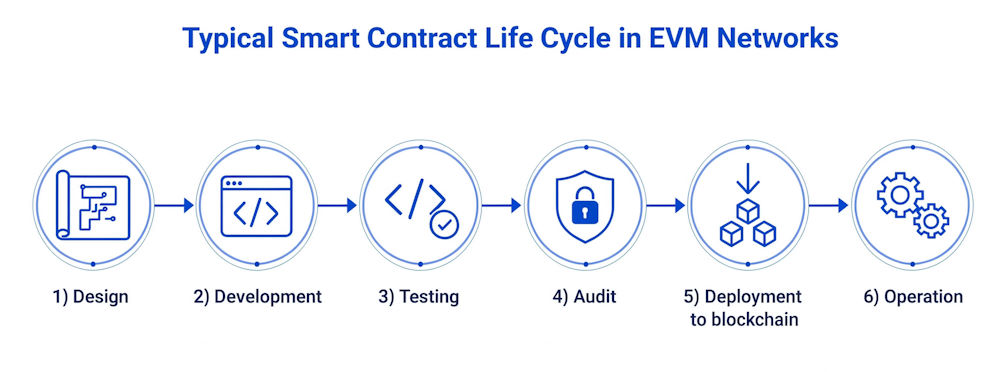
The operation of a smart contract fits into four consecutive stages. Understanding this cycle is critical: typical vulnerabilities and failure points arise precisely at each of these stages.
Stage 1. Writing Code
The developer describes the contract logic in a specialized language. The most common is Solidity (Ethereum, BNB Chain, Polygon, Avalanche C-Chain, and other EVM-compatible networks). Alternatives: Rust (Solana, Near), Move (Aptos, Sui), Vyper (a Python-like dialect for Ethereum), Cairo (StarkNet). The code describes: what data the contract stores, what conditions trigger what actions, and who is allowed to call specific functions.
Stage 2. Deployment to the Blockchain
After writing, the code is compiled into bytecode and sent to the network via a special transaction. Validators include it in a block, and the contract receives a unique address — the same as a regular wallet, but managed not by a private key but by its own logic. From that moment the code becomes public: anyone can read it in a block explorer and start interacting.
Stage 3. Initiation (Call)
A smart contract does not execute on its own. It is passive until someone sends a call transaction to its address. This can be a user via MetaMask or Trust Wallet, another smart contract, or an external service via an oracle. On a call, each node in the network executes the contract code with the supplied input data.
Stage 4. Execution and Recording of the Result
In Ethereum, execution happens inside the Ethereum Virtual Machine (EVM) — a deterministic environment that guarantees all nodes get the same result for the same input data. Changes (balance updates, token ownership change, new state recording) go into the next block. After several confirmations the transaction becomes irreversible.
Execution cost = Gas used × Gas price (in Ethereum and EVM networks).
Every operation in the code has a fixed cost in gas — this protects against infinite loops and resource abuse on the network.
Smart Contract Architecture
From a technical point of view, a smart contract consists of several layers. Understanding this architecture helps you consciously read others' code and write your own.
- Storage. The contract's permanent memory — variables, balances, owners. Every change in storage is expensive in gas.
- Memory. A temporary area that lives only within a single call. Cheaper than storage but cleared after execution.
- Stack. The working area for arithmetic and logical operations. Maximum 1024 elements, each 256 bits.
- Bytecode. The compiled machine code that the EVM executes. It is precisely this that is stored in the blockchain at the contract address.
- ABI (Application Binary Interface). A description of the interface: which functions are available, what parameters they accept, and what they return. Needed for external applications to interact with the contract.
Separately worth mentioning is the oracle — an external service that supplies the contract with real-world data. The contract itself is isolated from the internet: it cannot by itself learn the dollar exchange rate, the result of a football match, or the air temperature. For this, oracles are used — most often Chainlink, which aggregates data from many sources and delivers it to the blockchain via its own smart contracts. Without oracles, insurance payouts, lending against volatile assets, and most DeFi scenarios would be impossible.
Types of Smart Contracts
There is no single accepted classification, but in practice several dimensions are distinguished by which contracts differ.
By Logic Type
- Deterministic (logical). Execute clear "if X then Y" conditions. Example: issuing a token when a certain raise amount is reached.
- Non-deterministic. Interact with external data via oracles. Example: an insurance payout on a flight delay.
- Recursive. Call themselves or other contracts in a loop. Example: arbitrage bots in DeFi.
By Execution Environment
- Decentralized. Run in public blockchains (Ethereum, Solana). Executed by all nodes in the network.
- Centralized. Run in private distributed ledgers (Hyperledger Fabric, Corda). Used by enterprises for internal processes.
- Hybrid. Combine both approaches: logic in a public blockchain, data in a corporate system.
By Privacy Level
- Fully open. Code and all transactions are public.
- Partially private. State is hidden, but validators can verify it (zk-SNARKs in Tornado Cash, Aztec).
- Confidential. Used in corporate solutions with a limited circle of participants.
Smart Contract Example: Conditional Escrow
A classic example that clearly shows the mechanics is a conditional escrow contract. Imagine: party A sells party B a digital painting (NFT) for 1 ETH. Neither side trusts the other. The traditional solution is a notary or guarantor bank. The smart contract solution is code that locks both assets until confirmation.
Contract logic:
>1. Party B sends 1 ETH to the contract address — the funds are locked.
>2. Party A transfers the NFT (digital painting) to the contract address — the NFT is locked.
>3. The contract atomically exchanges the assets: it transfers 1 ETH to party A, and the NFT to party B. Both transactions occur in the same block.
>4. If one of the parties does not fulfill the conditions within the agreed period (for example, 7 days), either party can call the cancel function — the contract checks the current time and returns the assets to their owners.
The code works exactly as written. This is both the strength of the technology (no "I changed my mind") and its weakness (if there is an error in the logic, the money is lost forever). Every interaction with the contract requires payment of a network fee.
Applications of Smart Contracts in 2026
The application areas of smart contracts have long since gone beyond "transfer a coin on condition." Below are the main directions with real examples.
DeFi Smart Contracts
Decentralized finance is the largest consumer of the technology. Lending (Aave, Compound), decentralized exchanges (Uniswap, dYdX), staking pools, aggregators — all of this runs on smart contracts.
NFT and Tokenization of Real-World Assets (RWA)
An NFT is also a smart contract implementing the ERC-721 or ERC-1155 standard. But in 2026 the main trend is RWA (Real World Assets): tokenization of real estate, bonds, and commodities. The smart contract fixes ownership rights, and the legal wrapper binds the token to the real asset. BlackRock, Franklin Templeton, and other traditional funds are already issuing tokenized funds based on smart contracts.
Decentralized Autonomous Organizations (DAO)
A DAO is an organization whose rules are hard-coded in smart contracts. Voting, treasury distribution, and admission of new members are all automated. Examples: MakerDAO, Uniswap DAO, ConstitutionDAO.
Insurance, Logistics, Voting
- Insurance. Parametric policies: if an oracle recorded a flight delay of more than 3 hours, the payout goes automatically. Companies like Etherisc and Arbol work exactly this way.
- Logistics. Shipment tracking, automatic payments on delivery, product authenticity verification.
- Voting. Transparent and verifiable elections in DAOs, corporate voting, municipal initiatives.
Smart Contracts in Different Blockchains
Blockchain and smart contract technology develop unevenly: each network has its own philosophy and its own limitations.
| Blockchain | Language | Features | Market Share 2025-2026 |
|---|---|---|---|
| Ethereum | Solidity, Vyper | Benchmark, largest ecosystem, EVM | ~50% |
| Bitcoin | Bitcoin Script, via Taproot/BitVM | Limited but secure; new capabilities via L2 | Growing via L2 |
| Solana | Rust, C, C++ | High speed, low fees | In top-3 |
| BNB Chain | Solidity (EVM) | Integration with the Binance ecosystem | In top-5 |
| Cardano | Haskell (Plutus) | Academic approach, verifiable code | Moderate share |
| Ton | FunC, Tact | Telegram integration, asynchronous architecture | Rapid growth |
Worth noting separately is the Binance smart contract — referring to BNB Smart Chain, which uses the EVM and allows Ethereum contracts to be ported with minimal changes. This makes it a popular choice for projects that need low fees while maintaining compatibility with Ethereum tooling.
Bitcoin Smart Contracts: Myths and Reality
A common myth: "Bitcoin does not support smart contracts." That is not true. Bitcoin Script is a limited but functional language. With the activation of Taproot, capabilities expanded: complex conditions became more compact, cheaper, and more private. Through L2 solutions (Stacks, Rootstock) and experimental frameworks (BitVM), full-fledged DeFi scenarios can be implemented on Bitcoin without changing the base consensus.
However, it is important to understand the difference: Bitcoin fundamentally does not aspire to become a "world computer" like Ethereum. Its philosophy is to be the most reliable settlement layer possible, while complex logic moves to L2.
Advantages and Disadvantages of Smart Contracts
The technology is not universal. It has real advantages and no less real limitations.
| Advantages | Disadvantages |
|---|---|
| Autonomy: execution without intermediaries | Immutability: a code error cannot be fixed |
| Transparency: code is public and verifiable | Oracle dependency: external input is a vulnerability point |
| Security: cryptographic protection | Code risks: vulnerabilities lead to loss of funds |
| Accuracy: human factor eliminated | Legal uncertainty in many jurisdictions |
| Speed: automation accelerates processes | Scalability: as load grows, fees grow |
| Availability: 24/7 from anywhere in the world | Complexity: high entry barrier for developers |
Smart Contract Security and Risks
Smart contract security is a separate discipline, because the cost of an error here is measured in millions of dollars. Unlike a regular application, a software bug in a contract cannot be fixed — the code is already on the blockchain.
Typical Vulnerabilities
- Reentrancy. The contract calls an external contract before updating its own state. Example — the 2016 DAO hack.
- Integer overflow or exhaustion Partially solved at the compiler level in Solidity 0.8+.
- Oracle manipulation. Price manipulation through illiquid pools on a DEX. The attacker artificially inflates or deflates the price to deceive a lending protocol.
- Access control check errors. Someone gains the ability to call a function that should be closed.
- Front-running. Miners or validators see a transaction in the mempool and insert their own before it, extracting profit.
- Logic errors. Banal errors in business logic that are not visible when reading the code superficially.
Scam
A smart contract is a tool, and like any tool it is used by scammers. Typical fraud schemes:
- Honeypot. The contract allows you to buy the token but blocks the sale. Victims buy in, the price rises, but you cannot withdraw funds.
- Unlimited mint function. The contract owner can mint an unlimited number of tokens at any time and crash the price.
- Hidden fees. On every transaction, 99% is deducted to the contract owner's address.
- Pause mechanisms. The owner can pause the contract at any time and freeze users' funds.
- Fake airdrops. The contract asks you to sign a transaction that actually grants unlimited access to your tokens.
How to Check a Smart Contract for Fraud (Scam)
Before interacting with any new contract (buying a token, staking, NFT mint), run a check. This is not a guarantee, but it filters out a significant portion of outright fraudulent junk.
- Check code verification. In Etherscan, BscScan, and other explorers, a verified contract shows its source code. If the code is not verified, that is a red flag.
- Use automated scanners. Services like Token Sniffer, GoPlus Security, Honeypot.is, and De.Fi Scanner analyze the contract for typical vulnerabilities and fraud patterns.
- Study the contract functions. Pay attention to:
mint()(who can mint?),pause()(who can stop it?),setFee()(can the fee be changed retroactively?),blacklist()(can your address be blocked?). - Check the audit. The presence of an audit from a known company (OpenZeppelin, Trail of Bits, Consensys Diligence, CertiK) is a positive but not absolute signal. Audits also miss vulnerabilities.
- Look at the holders. If 80% of tokens are in one wallet, that is a red risk zone. You can check in Etherscan under the "Holders" tab.
- Assess liquidity. Is the liquidity pool locked? For how long? If it is not locked, the developer can withdraw the liquidity at any time.
Practical rule: if a contract is not verified, has not passed an audit, and has suspicious functions — do not interact with it.
Smart Contract Market in 2026
The technology has ceased to be the domain of crypto enthusiasts.
- According to some estimates, the global smart contract market is valued at $3.39 billion in 2026, with a forecast to grow to $16.31 billion by 2034.
- Ethereum holds around 50% of the market among smart contract platforms.
- BlackRock, Franklin Templeton, and JPMorgan use smart contracts for asset tokenization.
Learning Smart Contracts: Where to Start
If you are a developer and want to write smart contracts, here is a minimal route:
- Master Solidity. The official Solidity documentation and CryptoZombies (an interactive course).
- Understand the EVM. Learn how gas, storage, memory, and the stack work.
- Practice in test networks. Sepolia and Holesky for Ethereum. Hardhat and Foundry are the two main frameworks for development and testing.
- Study security.
- Read others' code. The contracts of Uniswap, Aave, and OpenZeppelin Standards are open and excellently documented.
Frequently Asked Questions (FAQ)
The code itself — no, it is immutable. However, developers embed a proxy contract pattern, which allows updating the logic while preserving the address and state. This is a compromise between immutability and the need to fix errors.
Developing a simple contract costs roughly from $1,000 to $10,000, while a complex DeFi protocol costs roughly from $50,000 to several hundred thousand. Deployment to Ethereum can cost from $50 to $1,000 depending on network load. In L2 solutions (Arbitrum, Base, Optimism), the cost is tens of times cheaper.
It depends on the jurisdiction. In the US, several states (Arizona, Vermont, Wyoming) recognize smart contracts as legally significant. In Russia, the Central Bank of the Russian Federation is reviewing the possibilities. In most countries the status remains undefined.
A regular contract is text on paper that, if violated, must be defended in court. A smart contract is executable code that automatically applies sanctions when the specified conditions occur. The legal wrapper and the code are different things that ideally should complement each other.
This is a 42-character identifier (for example, 0x1234...abcd in Ethereum) by which the contract is accessible on the network. Using the address you can find the contract in a block explorer, read its code, and interact with it.
Yes, Trust Wallet supports interaction with smart contracts through the built-in DApp browser and the "Smart Contracts" feature. You can call a specific contract function by specifying its address and ABI.
Conclusion
A smart contract is not a "magic pill" for business and not "absolutely secure code," as is sometimes claimed in promo materials. It is a powerful but demanding tool. It provides autonomy, transparency, and speed where these properties are critical. But it also imposes strict requirements on code quality, understanding of architecture, and user discipline.
In 2026, the technology has moved from the category of "crypto-exotic" to the category of "infrastructure layer." Huge DeFi volumes pass through smart contracts, and real assets are being tokenized. And this trend, it seems, will only strengthen: the market is growing, regulators are gradually legalizing, and the traditional financial sector is integrating.
For the user, the main thing is to remember: code is law, but the law is not always fair. Check contracts before interacting, do not trust promises of colossal profits, and study basic security hygiene. Then the technology will reveal its strengths rather than become a source of losses.
Disclaimer
This article is for informational and educational purposes only, may become outdated, and may contain errors and inaccuracies. It is not financial advice, an invitation to act, or professional consultation. Always do your own research and consult with independent specialists. Cryptocurrencies and investing carry the risk of a complete loss of invested funds; returns are not guaranteed.