What is a DApp in cryptocurrency
Published: 11.07.2026 • Updated: 14.09.2026 • Author: Fedor Sokolovskiy
If you need a quick answer, here is the gist:
- Decentralized applications (DApp) are programs whose backend runs on a blockchain rather than on private servers. The logic is executed by smart contracts.
- To interact, you don't need email and passwords: it is enough to connect a wallet dapp (crypto wallet) that acts as your digital identifier.
- The main advantages are censorship resistance, code transparency, and the absence of a single point of failure. However, the network faces scalability problems and a complex user experience (UX).
- Popular solutions like Trust Wallet DApp simplify access to the Web3 ecosystem, but users should remember the risks of smart contract exploits and phishing.
Next, let's look at the details.
What are decentralized applications (DApp)?
Simply put, dapp in cryptocurrency refers to digital services that do not belong to a single corporation. Instead of being stored on a company's centralized servers (like banking apps, for example), their code is placed in a distributed network of nodes.
The term crypto dapp is often used as a synonym for Web3 applications. The user sees a familiar interface: buttons, forms, charts. But under the hood, a completely different mechanism is at work. Any action — from swapping tokens to buying an in-game item — is a transaction that is written to the blockchain and verified by the network.
DApp architecture and how it works
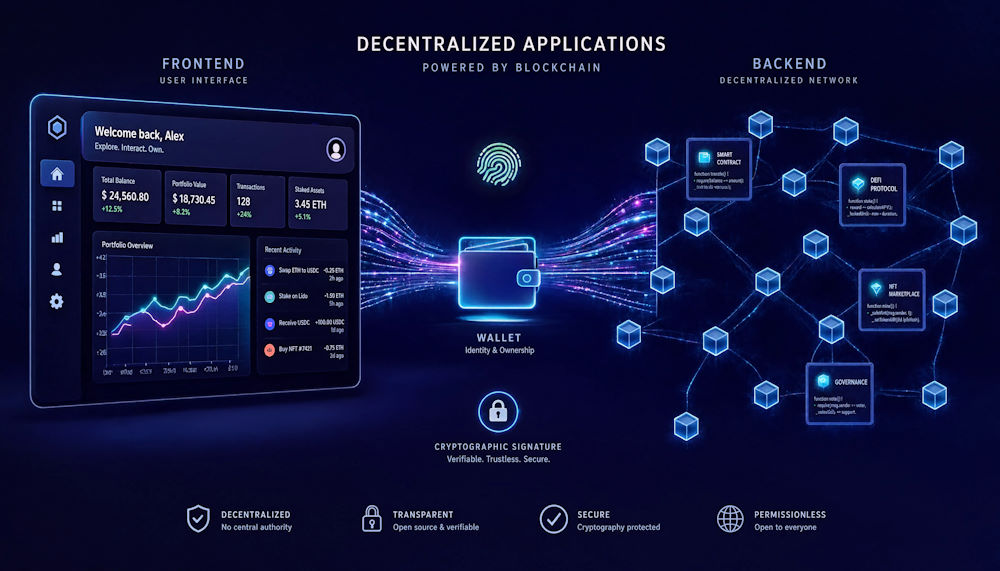
To understand why these systems are called decentralized, you need to examine their anatomy. Any dapp consists of two inextricably linked parts.
Smart contracts as the foundation (backend)
The backend is the server-side part, the application logic written as smart contracts. A smart contract is a set of algorithms that are automatically executed when certain conditions are met.
For example, in a decentralized exchange (DEX), the smart contract itself matches buy and sell orders, calculates the price, and transfers assets. There is no broker or manager who could freeze an account or cancel a trade. Code is law.
Frontend and user interface
The frontend is what the user sees (a website or mobile app). It can be written in standard languages (HTML, CSS, JavaScript) and even hosted on regular servers. However, instead of sending requests to the company's database, the frontend communicates with the blockchain through special libraries (such as Web3.js or Ethers.js).
For full decentralization, the frontend is also hosted in distributed file storage such as IPFS, so that no one can take the site offline.
Key differences from traditional apps
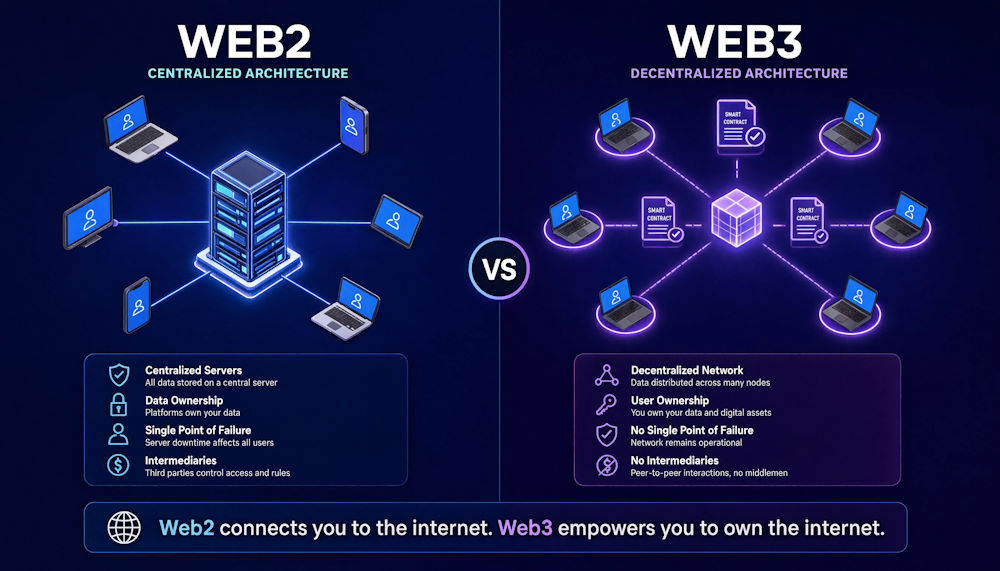
Why do developers and users choose decentralized applications dapps when ordinary services are faster and more convenient? The answer lies in the fundamental differences in the philosophy of data ownership.
| Feature | Traditional application (Web2) | Decentralized application (Web3) |
|---|---|---|
| Data storage | Centralized company servers | Distributed blockchain and IPFS |
| Authorization | Email, password, phone, social networks | Cryptographic key (wallet) |
| Control over assets | Balance on an internal account | Direct ownership of tokens on the network |
| Source code | Closed (proprietary) | Open Source, available for audit |
| Censorship resistance | An admin can block the account | No one can forbid a transaction |
| Downtime | Possible server failures and DDoS attacks | The network runs as long as nodes are running |
How to interact with DApp: the role of a crypto wallet
On the traditional internet you create an account. In Web3 your identity is represented by a dapp wallet. It is not just a place to store coins, but your cryptographic passport and a tool for signing transactions.
When you visit a crypto dapp, the site asks you to connect your wallet. You do not hand your funds to the site — you only grant permission to read your public address and to sign specific actions with your private key.
Mobile access and Trust Wallet DApp
One of the most popular tools for accessing Web3 is Trust Wallet. The built-in Trust Wallet DApp browser lets Android and iOS users interact with decentralized exchanges, lending protocols, and NFT marketplaces right from their smartphone.
It is important to understand: the wallet does not store your coins "inside" the app; it stores the private key that provides access to the records on the blockchain.
Use cases and examples
The dapps app ecosystem spans dozens of industries. Let's look at the main areas.
- Decentralized finance (DeFi): Protocols like Uniswap or Aave let you take loans, trade, and earn interest without banks. Important: staking and liquidity pools do not guarantee returns. There are risks of irreversible losses and code vulnerabilities.
- Games (GameFi): Games where in-game items (weapons, land, characters) are NFTs that the player owns on the blockchain level.
- Social networks and media: Platforms where content cannot be deleted by the administration, and authors receive rewards directly from the audience in the form of tokens.
- Governance (DAO): Decentralized autonomous organizations where token holders vote on the development of the protocol.
Scaling problems and drawbacks
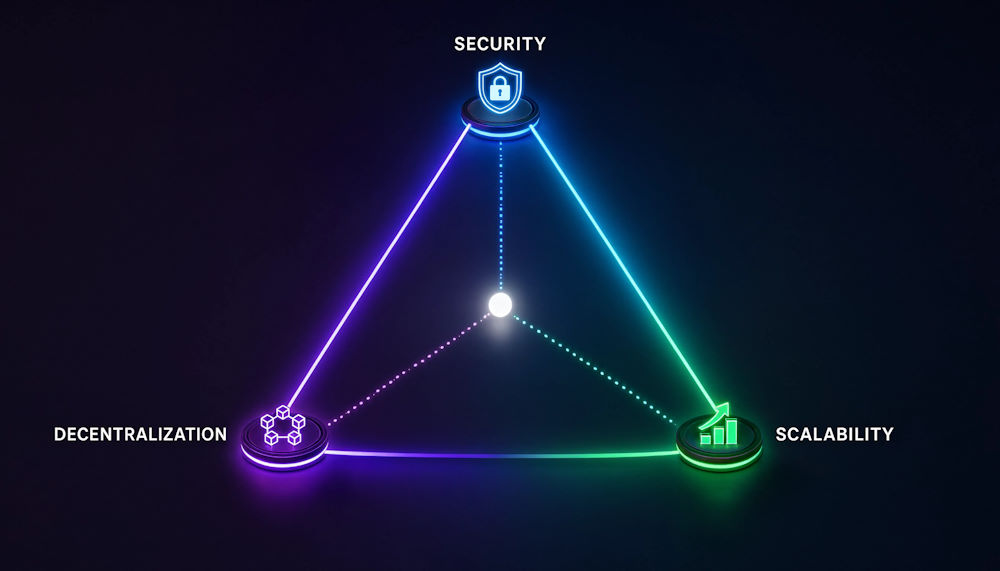
Despite the ideological appeal, decentralized applications face harsh reality. A blockchain is not always "fast and cheap." This is where the scalability trilemma comes into play: it is hard to simultaneously ensure high security, decentralization, and throughput. It's like the common joke about fast, high-quality, and cheap at the same time — that almost never happens in real life.
- High fees (Gas): On networks like Ethereum (L1), every operation requires payment for computing resources. When the network is congested, fees can reach tens of dollars.
- Low speed: Base networks process 15–30 transactions per second, while Visa handles tens of thousands.
- Difficulty of updates: If in a traditional app a developer can release a fix for a bug or vulnerability within an hour, in a DApp changing a smart contract requires network consensus.
- Entry barrier: The user needs to understand what networks, gas, and fees are, and how to sign transactions.
Transaction fee (Gas Fee) = Amount of gas used (Gas Used) × Gas price (Gas Price)
To solve these problems, layer-2 networks (L2) such as Arbitrum or Optimism are actively developing. They take on the main load while preserving the security of the main blockchain.
Security and risks
The myth of complete anonymity and security of a DApp needs to be dispelled right away.
- Pseudonymity, not anonymity: Cryptocurrency is pseudonymous. All your transactions are public and permanently recorded on the blockchain. Specialized services (such as Chainalysis) can de-anonymize an address by linking it to your identity through exchanges or IP addresses. Read more in the article about cryptocurrency anonymity.
- Smart contract vulnerabilities: Code can contain errors. If a hacker finds a vulnerability in the DApp code, they can drain all the funds locked there. It will be impossible to recover them.
- Phishing and scams: Attackers create copies of popular sites to steal seed phrases or trick users into signing a malicious transaction that drains funds.
The future of decentralized applications
The DApp mass-adoption index is growing. The introduction of account abstraction will make it possible to use a DApp without needing to store seed phrases: login will be done via biometrics, social logins, or smart-contract wallets. This will blur the line between Web2 and Web3, making dapp apps as convenient as their centralized counterparts, while preserving the main principle — sovereign data ownership.
Frequently asked questions (FAQ)
Regular apps store data and logic on the private servers of the owning company. A DApp uses the blockchain and smart contracts, which eliminates a single center of control and censorship.
Yes, you will need a non-custodial wallet (such as MetaMask, Trust Wallet, or Rabby) that supports interaction with the required blockchain network and transaction signing.
The wallets themselves and their DApp browsers are safe, but you interact with external sites. Always check URLs, do not connect to suspicious protocols, and never enter your seed phrase on third-party resources.
Every operation requires computing resources from the network's validators. If the network is congested, users start competing for space in a block, driving up the fee (gas). The solution is to use layer-2 networks (L2).
In the long run — yes, but to do so we must solve the problems of scalability and user experience (UX). The introduction of account abstraction and L2 solutions is already actively blurring the boundaries between Web2 and Web3.
Disclaimer
This article is for informational and educational purposes only, may become outdated, and may contain errors and inaccuracies. It is not financial advice, an invitation to act, or professional consultation. Always do your own research and consult with independent specialists. Cryptocurrencies and investing carry the risk of a complete loss of invested funds; returns are not guaranteed.