Are cryptocurrencies actually anonymous
Published: 09.07.2026 • Updated: 14.09.2026 • Author: Fedor Sokolovskiy
- The myth about Bitcoin's anonymity
- Privacy technologies: how real anonymity works
- Comparison of anonymous cryptocurrencies: Monero, Zcash, Dash and others
- Deanonymization methods: how you can be identified
- Legal status: where they are allowed, where they are banned?
- Practical guide: how to increase anonymity
- The future of privacy: an arms race
If you need a short answer to the question of whether cryptocurrencies are anonymous or if that is just a popular myth, here is the essence:
- Bitcoin, Ethereum, and the vast majority of cryptocurrencies are not anonymous, but pseudonymous, because all transactions are public and traceable. They are anonymous only in the sense that, for a while, no one knows who owns a particular wallet, and there are many ways to determine the owner.
- True anonymity is achieved only through specialized protocols: zk-SNARKs (Zcash), ring signatures and FCMP++ (Monero), CoinJoin.
- Modern blockchain analytics and AML-checking tools, such as Chainalysis, Elliptic, AMLBot, Crystal Blockchain and others, easily deanonymize cryptocurrency users through blockchain analysis.
- By depositing cryptocurrency on any centralized platform or KYC exchange, you are instantly deanonymized along with the entire chain of how the cryptocurrency came to you.
- Anonymous cryptocurrencies face mass delistings due to regulatory pressure (FATF, OFAC and others).
- It is far wiser to act within the law and sleep peacefully, rather than hide behind illusory anonymity.
Next, we will take a closer look at how anonymization works in cryptocurrencies, the strengths and weaknesses of privacy coins, and the rules of digital hygiene.
The myth about Bitcoin's anonymity
When Satoshi Nakamoto introduced Bitcoin in 2008, many perceived it as a tool for fully anonymous payments. This misconception became one of the most persistent myths in the crypto industry. In reality, cryptocurrency anonymity in classic blockchains is more of a marketing myth than a technical reality.
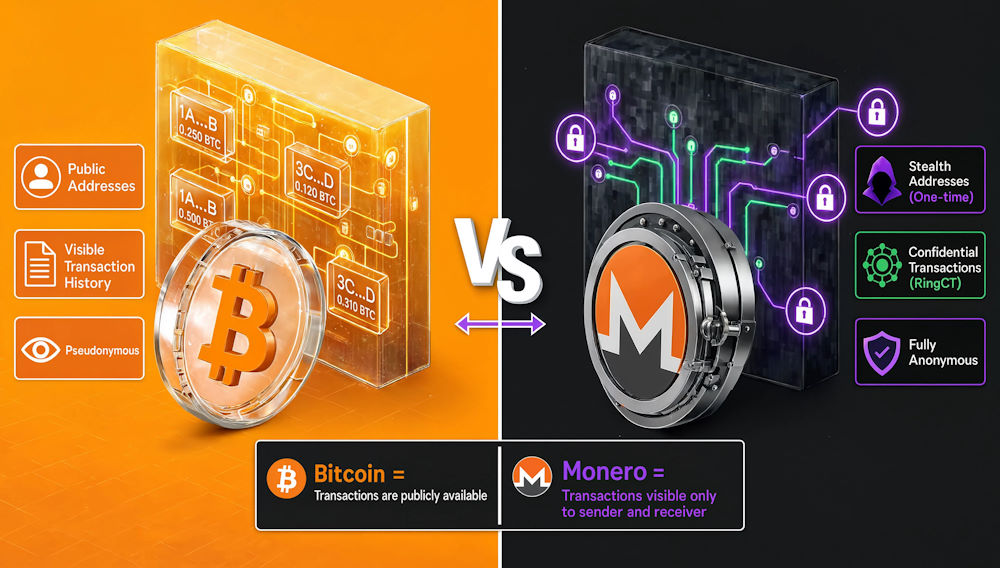
Bitcoin uses a pseudonymous model: instead of a username, a cryptographic address appears in the ledger (for example, bc1qxy2kgd...). But this address is not a wall, but rather a semi-transparent screen. It only takes one link between a single transaction and a specific user for the entire chain and transaction history to become transparent.
Pseudonymity ≠ Anonymity. A pseudonym is a persistent identifier (address) that can be tied to a person. Anonymity is the absence of any identifier.
How you get deanonymized: 5 main methods
Modern blockchain analytics companies use a comprehensive approach to tracking:
- Transaction pattern analysis (Heuristic analysis). Algorithms identify clusters of addresses belonging to a single user. For example, if several addresses are used as inputs in one transaction, they are automatically grouped.
- Entry/exit points. The moment you convert crypto to fiat through a KYC exchange is the "moment of truth". Once an address is linked to your passport, your entire transaction history is tied to your identity.
- Network analytics. Recording IP addresses as transactions pass through nodes.
- Timing attacks. Correlating the time of a transaction with other events (for example, your social media post or a purchase).
- Device fingerprints. Any device on the network has a digital fingerprint. These fingerprints are linked to a specific person and analyzed together with other data.
According to Chainalysis, in 2023 the volume of illegal transactions in Bitcoin amounted to just 0.34% of the total volume, but it is precisely pseudonymity that allows a significant portion of criminal schemes to be tracked.
Privacy technologies: how real anonymity works
To achieve genuine untraceability, cryptographers have developed several mathematical methods. Each solves its own task: hiding the sender, the recipient, or the transaction amount.
Stealth addresses
This technology solves the problem of linking the recipient. In ordinary blockchains, if you have published your address once (for example, on a website), all your future incoming payments become visible.
Stealth addresses generate a one-time address for each transaction. The mathematics of the process:
The sender creates a one-time public key: P = B + H(rA)G, where B is the recipient's spend public key, A is their view public key, r is a random number, G is the elliptic curve generator, H is a hash function.
Only the recipient, knowing their private key, can "see" these funds and spend them. To an outside observer, each transaction looks like a transfer to a new, never-before-used address.
Ring signatures and the evolution of Monero
A ring signature hides the sender of a transaction. The algorithm takes your real input and adds several "decoy" inputs from other blockchain transactions. Then a mathematical signature is created that proves that someone from the group signed the transaction, but it is impossible to determine who exactly.
In Monero, the ring size is 16 participants (1 real + 15 fake). This means that the mathematical probability of guessing the sender "head-on" is 1/16 or ~6.25%. However, in practice, pattern analysis and statistical methods allow analysts to filter out the fake senders, thereby reducing the effective size of the anonymity set and significantly increasing the probability of deanonymization.
FCMP++ - a privacy revolution for Monero (2026)
In January 2026, the largest cryptographic upgrade in Monero's history was activated on the network - FCMP++ (Full-Chain Membership Proofs). It completely replaced the classic ring signatures with a new proof scheme.
The essence of the technology: instead of selecting 15 fake inputs from recent transactions, FCMP++ proves that the real input belongs to the entire Monero chain - and that is more than 100 million transactions. To an outside observer, every input now looks like any other from the entire blockchain history.
Key difference: if ring signatures hid the sender among 16 addresses, then FCMP++ hides them among 100,000,000+ transactions.
This upgrade made Monero virtually immune to classic heuristic attacks of blockchain analytics. However, the protocol still requires discipline from the user: hiding the IP address, running one's own node, and avoiding KYC exchanges remain mandatory.
Zero-knowledge proofs (zk-SNARKs)
This is the "heavy artillery" of cryptography. A zk-SNARK (Zero-Knowledge Succinct Non-Interactive Argument of Knowledge) allows you to prove that a transaction is valid (balances match, signatures are correct), without revealing either the sender, the recipient, or the amount.
In Zcash this is implemented through "shielded" transactions. The user can choose:
- t-addr: a regular public transaction, like in Bitcoin.
- z-addr: a fully hidden transaction using zk-SNARKs.
The problem with Zcash: optional privacy. Although the share of shielded transactions is growing, a significant part of the network remains transparent. This critically reduces the degree of anonymity for those who stand out from the crowd.
CoinJoin and mixers
This is not a separate coin, but a protocol that can be used in any blockchain (most often Bitcoin). The idea: several users combine their transactions into one large transaction, where it is difficult to understand who pays whom.
Important nuance: CoinJoin is not cryptographically secure. Modern analytical tools (for example, CoinJoin-deanonymization from Chainalysis) can "split" mixed transactions by analyzing timestamps, amounts, and input/output patterns.
Comparison of anonymous cryptocurrencies: Monero, Zcash, Dash and others
Not all anonymous cryptocurrencies are the same. The key difference is whether privacy is mandatory (default) or optional.
| Parameter | Monero (XMR) | Zcash (ZEC) | Dash (DASH) | Beam/Grin |
|---|---|---|---|---|
| Privacy type | Mandatory (by default) | Optional | Optional (mixing) | Mandatory |
| Technology | FCMP++ / Ring signatures + Stealth addresses + RingCT | Zero-knowledge proofs (zk-SNARKs) | CoinJoin (PrivateSend) | Mimblewimble (Pedersen commitments) |
| Amount hiding | Yes (RingCT) | Yes (in shielded transactions) | No | Yes |
| Sender hiding | Yes | Yes (in shielded transactions) | Partial | Yes |
| Recipient hiding | Yes | Yes (in shielded transactions) | No | Partial / Depends on implementation |
| Emission audit | Impossible (amounts hidden) | Possible (via view key) | Possible | Limited |
Monero: the "gold standard" of privacy
Monero uses a combination of technologies: FCMP++ (sender), stealth addresses (recipient) and RingCT (amount). Privacy is built into the protocol - you cannot send a public transaction even if you want to.
This provides the maximum crowd effect: since all transactions are equally hidden, the blockchain analyst has no "control group" of transparent operations to latch onto. Unlike Zcash, where using a shielded address itself makes the user stand out from the crowd, in Monero there is simply no one to stand out - and nothing to stand out for.
However, Monero is not perfect. Researchers show that with insufficient user discipline (IP leaks, use of KYC exchanges), indirect methods of deanonymization are possible.
Zcash: mathematical perfection and the privacy paradox
Zcash uses zk-SNARKs - one of the most powerful cryptographic technologies. Theoretically, a shielded transaction in Zcash is immune to any analysis. But the problem is that privacy in Zcash remains optional.
By 2026, the usage statistics of shielded transactions had improved significantly compared to earlier years:
- Share of shielded transactions reached 40-59% of the total number of operations (a peak of 59.3% was recorded in February 2026).
- Shielded supply (the share of coins in the shielded pool) grew from 8% at the beginning of 2024 to approximately 30% by mid-2026.
This creates a privacy paradox: despite the growth, many operations are still conducted in transparent mode. If you use a shielded address, you automatically fall into a smaller group of users, which makes your operations more noticeable to regulators and analytical algorithms.
Dash and Mimblewimble (Beam/Grin)
Dash uses PrivateSend - a modification of CoinJoin. This is not real cryptographic privacy, but rather "obfuscation of trails". Analytical tools easily deanonymize Dash given a sufficient volume of data.
Beam and Grin use the Mimblewimble protocol, which hides amounts and combines transactions. There is an important architectural difference here:
- Beam uses stealth addresses, which provides recipient privacy at the protocol level.
- Grin fundamentally does not use addresses at all - this is a feature of the Mimblewimble architecture. Interaction between the sender and the recipient occurs through a direct data exchange session. This provides privacy, but complicates the user experience: you cannot simply copy an address and send coins asynchronously.
The MWEB vulnerability in Litecoin: a lesson from 2026
In April 2026, a critical incident occurred on the Litecoin network, calling into question the security of the Mimblewimble Extension Blocks (MWEB) protocol. Attackers discovered a vulnerability in the implementation and were able to create 85,000 LTC out of thin air, exploiting a validation error.
To remedy the consequences, the network had to carry out an unprecedented event - a 13-block reorganization, rolling back the chain to the moment before the exploit. Within two months, the developers released 5 security patches.
This case is an important reminder: even "private" add-ons on top of public blockchains require years of auditing. Users of MWEB transactions in Litecoin should exercise increased caution and monitor protocol updates.
Deanonymization methods: how you can be identified
Even using Monero does not guarantee 100% anonymity. Here are real failure scenarios:
- User errors. You published your Monero address on social media, and then used it to receive cryptocurrency. Your entire financial history is exposed.
- Wallet-level leaks. Some mobile wallets send metadata (IP address, device identifier) to their servers. Use only trusted anonymous cryptocurrency wallets with open source code (for example, the official Monero wallet).
- Network-level attacks. If you do not hide your IP address, it becomes visible to the nodes relaying the transaction.
- Operator errors. Buying Monero on a KYC exchange → withdrawing to a private wallet → sending to a friend. The exchange knows you bought XMR, and can track the moment of withdrawal.
Tornado Cash: the sanctions precedent and the court verdict
In August 2022, OFAC (U.S. Office of Foreign Assets Control) added the Tornado Cash smart contracts to the sanctions list. This was the first case where code was recognized as a "weapon". Anyone who used Tornado Cash after that date risks being accused of violating sanctions.
Roman Storm, co-founder of Tornado Cash, was arrested in August 2023. The trial concluded in August 2025 with the following verdict:
- Found guilty on one count - conspiracy to operate an unlicensed money transmitting business.
- The jury could not reach a unanimous verdict on the more serious charges: money laundering and sanctions violations.
- Storm remains free on bail pending a retrial on the "hung" counts of the indictment.
This precedent created a dangerous trend: regulators can pursue not only users, but also the developers of privacy protocols, even if the code is open and decentralized.
Legal status: where they are allowed, where they are banned?
The regulatory landscape for anonymous cryptocurrencies is constantly tightening. FATF (Financial Action Task Force) recommends that countries adopt laws requiring exchanges to transmit information about the parties to a transaction.
| Country / Region | Status of anonymous cryptocurrencies | Notes |
|---|---|---|
| Japan | Banned on exchanges since 2018 | First major jurisdiction to ban XMR, ZEC, DASH |
| South Korea | Banned on exchanges since 2021 | Mass delisting of Monero, Zcash, Dash in March 2021 at the FSC's request |
| UAE (Dubai) | Banned since 2023 | VARA does not license operations with anonymous cryptocurrencies |
| European Union | Full ban from July 1, 2027 | TFR regulation. DAC8 (tax reporting) in effect since January 1, 2026 |
| USA | Allowed, but under pressure | Mass delistings on Binance US, Kraken, OKX. Tornado Cash precedent |
| Russia | A large-scale law is being prepared | Planned for July 1, 2026, but postponed, tentatively, to September 1, 2026. |
The trend is obvious: centralized exchanges are mass-delisting anonymous cryptocurrencies. Binance, OKX, Huobi removed Monero and Zcash in most jurisdictions. This creates a liquidity problem: anonymous coins simply become difficult to buy.
Practical guide: how to increase anonymity
To improve privacy, it is not enough to simply buy Monero. You need to use non-custodial open-source wallets, official wallets, and hardware wallets. And you must avoid using exchange wallets, online KYC services, and publishing wallet addresses in the open.
2. Anonymous cryptocurrency exchanger
Buying Monero on a KYC exchange is the moment when anonymity is nullified. Alternatives:
- P2P platforms without KYC: Bisq, HodlHodl, RoboSats (for Bitcoin). LocalMonero closed in November 2024, but alternatives have appeared: Haveno, Komodo DEX and others.
- Automatic exchangers of the type: FixedFloat, SimpleSwap, ChangeNow. They do not require KYC for small amounts, but may hand over data upon request from law enforcement.
- Atomic swaps: decentralized exchange BTC ↔ XMR via HTLC (Hash Time-Locked Contracts) and PTLC (Point Time-Locked Contracts) protocols. Specialized platforms: BasicSwap (based on Particl), Serai DEX.
Important: Any anonymous cryptocurrency exchanger may in fact turn out to be pseudonymous.
3. Network security
- Hiding the IP address: Without hiding your IP, you should not count on transaction anonymity.
- Running your own node: Self-hosting a full Monero node. This eliminates address leakage through public nodes.
- Specialized operating system: For maximum isolation, you can use specialized OSes, such as Whonix or Qubes OS
4. Avoid privacy mistakes
- Do not publish your addresses on social media.
- Do not use the same wallets for public and private operations.
- Do not trust "anonymous" messengers for discussing transactions.
- Use hardware wallets (Ledger, Trezor or equivalents) for storing large amounts.
The future of privacy: an arms race
The confrontation between cryptographers and regulators is an "arms race". On the one hand, new technologies are emerging:
- Fully Homomorphic Encryption (FHE): a technology that allows computations to be performed on encrypted data without the need to decrypt it beforehand.
- Mimblewimble Extension Blocks (MWEB): a privacy protocol integrated into the Litecoin network to hide the amounts and participants of transactions.
- zk-Rollups: a second-layer (L2) solution for Ethereum that uses zero-knowledge proofs to provide privacy and scalability.
On the other hand, regulators are developing more powerful analysis tools. Chainalysis can already deanonymize some CoinJoin transactions, and AI algorithms are improving heuristic analysis.
Conclusion: full anonymity, if possible at all, requires technical knowledge and discipline. For 99% of users, "everyday privacy" is enough: periodically changing addresses, not publishing wallet addresses publicly, using widely recognized cryptocurrency platforms. It is far wiser to monitor legislation, comply with it, and sleep peacefully. The global trend is centralization and deanonymization of cryptocurrency transactions.
Frequently asked questions
Probably Monero (XMR) is considered the most anonymous cryptocurrency thanks to mandatory privacy by default, the use of FCMP++, stealth addresses and RingCT. Unlike Zcash, where privacy is optional, in Monero all transactions are hidden, which creates the maximum "crowd effect".
Theoretically - yes, but in practice it is extremely difficult. Modern analytical tools cannot reliably deanonymize Monero thanks to the FCMP++ upgrade. However, user errors (publishing an address, using KYC exchanges, IP leaks) can reveal identity. Monero's cryptography itself is considered reliable.
Exchanges face pressure from regulators (FATF, OFAC), who demand compliance with AML requirements. Anonymous coins complicate transaction tracking, which creates risks for exchanges. To retain licenses in major jurisdictions (USA, EU, Japan), exchanges mass-delist anonymous coins.
Bitcoin is pseudonymous, but not anonymous. For anonymity, it is better to use Monero or Zcash in shielded mode.
Conclusion
Cryptocurrency anonymity - this is not a binary state, but a spectrum. Bitcoin provides pseudonymity, which is easily destroyed with insufficient caution. At first glance, Monero and Zcash offer real cryptographic privacy, but they require technical knowledge and discipline, and greatly limit the ability to actually use your cryptocurrency.
Disclaimer
This article is for informational and educational purposes only, may become outdated, and may contain errors and inaccuracies. It is not financial advice, an invitation to act, or professional consultation. Always do your own research and consult with independent specialists. Cryptocurrencies and investing carry the risk of a complete loss of invested funds; returns are not guaranteed.