What is market capitalization and why it matters
Published: 07.07.2026 • Updated: 14.09.2026 • Author: Fedor Sokolovskiy
- What is cryptocurrency market capitalization
- Market cap calculation formula
- Types of market cap in cryptocurrencies
- Circulating Market Cap
- Fully Diluted Valuation (FDV)
- Why token price is not the main indicator
- Market cap and trading volume: what is the difference
- Impact of emission and halving on market cap
- Limitations of the market capitalization metric
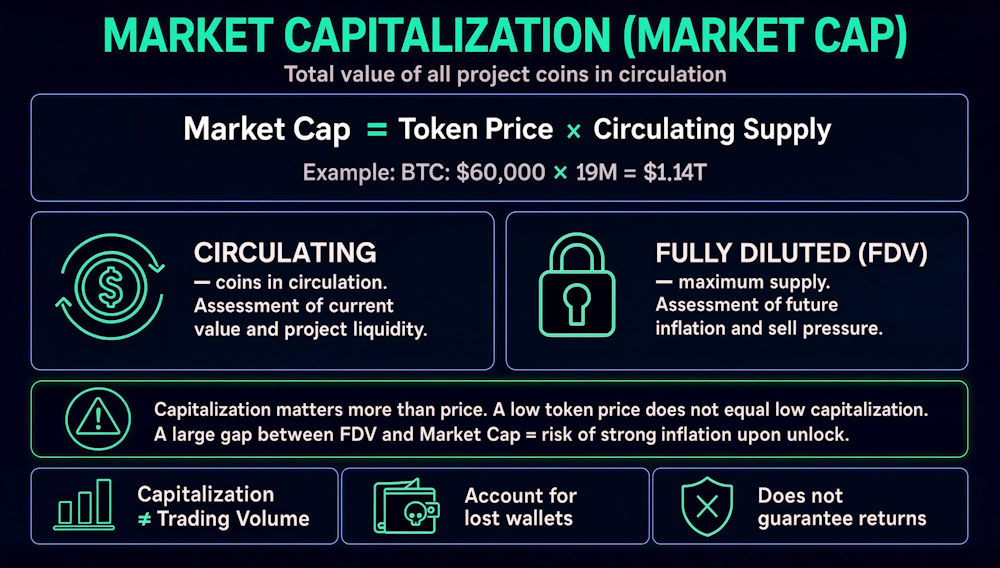
Market capitalization (Market Cap) is the total value of all coins of a project that are in circulation, calculated as the current price multiplied by the number of available tokens.
- Market cap matters more than price: A low token price does not mean the project is "cheap" or undervalued; the key factor is precisely the size of its market capitalization.
- Types of market cap: There is a distinction between fully diluted (Fully Diluted Valuation) and circulating capitalization. A large gap between them signals inflation risks when tokens are unlocked.
- An evaluation tool: Market cap helps compare projects against each other and determine their position in the market, but it does not guarantee future returns.
What is cryptocurrency market capitalization
In traditional finance, a company's market capitalization shows its total value on the stock exchange. Cryptocurrency market capitalization shows the combined value of all coins of a specific project that are currently available for trading.
This metric is a fundamental indicator that allows investors to assess the scale of a project, its liquidity, and its growth potential. Unlike the price of a single coin, which can be low simply because of a huge number of issued units, market cap provides a more objective picture of an asset's real standing in the market.
Market cap calculation formula
The calculation of basic market capitalization is extremely simple and is based on two variables:
Market Capitalization = Current Token Price × Circulating Supply
Where:
- Current token price is the latest trade price on leading cryptocurrency exchanges.
- Circulating Supply is the number of coins that have already been issued by the emitter and are in free circulation among users.
For example, if Bitcoin's current market price is $60,000 and 19 million coins are in circulation, its market capitalization will be $1.14 trillion.
Types of market cap in cryptocurrencies
When analyzing project tokenomics, it is important to distinguish between several valuation types, as they reflect different aspects of an asset's economic model.
Circulating Market Cap
This is the standard metric displayed on most aggregators (CoinMarketCap, CoinGecko). It takes into account only those tokens that actually exist and can be bought or sold right now. It is this parameter that is used to build cryptocurrency rankings.
Fully Diluted Valuation (FDV)
Fully Diluted Valuation (FDV), or full market cap, is calculated based on the maximum possible supply of the token (Max Supply), even if most of the coins have not yet been issued or are locked in smart contracts.
FDV = Current Token Price × Maximum Supply
This metric is critically important for assessing long-term risks. If a project's FDV significantly exceeds its current market capitalization, it means a huge number of new coins will enter the market in the future, creating selling pressure that can drive the price down all the way to zero. Scam projects often do exactly this: marketing pumps the price, and at the peak the owners start dumping their tokens, which sends the price crashing to zero.
| Parameter | Circulating Market Cap | Full Market Cap (FDV) |
|---|---|---|
| Calculation basis | Tokens in circulation | Maximum possible number of tokens |
| What it is used for | Assessing current value and liquidity | Assessing future inflation and selling pressure |
| Accuracy | High (based on facts) | Projected (depends on the emitter's plans) |
Why token price is not the main indicator
Beginners often make the mistake of thinking that a cryptocurrency priced at $0.1 has greater growth potential than an asset worth $100. This misconception ignores the law of supply and demand.
For a low-priced token to grow 10x, its market capitalization must also increase 10x. For projects that already have a huge capitalization, such growth requires tens of billions of dollars of new capital to flow in. At the same time, a small-cap project can multiply in value on a modest surge of interest, but it carries far higher risks of volatility and manipulation.
Market cap and trading volume: what is the difference
These two metrics are often confused, but they answer different questions:
- Market cap shows the total value of the network ("what the whole project is worth"). It is a static metric that changes along with the current price.
- Trading volume shows how much money changed hands over the last 24 hours. It is an indicator of activity and liquidity.
High market cap with low trading volume may indicate that no one is interested in the asset and it will be difficult to sell it at the current price (low liquidity). Conversely, a sharp spike in volume with stable market cap often foreshadows a strong price move.
Impact of emission and halving on market cap
Unlike fiat currencies, where central banks can print money uncontrollably, most cryptocurrencies have strict emission algorithms.
Bitcoin's halving is a classic example of how a reduction in the rate of new coin issuance affects the market. A decrease in supply, with demand holding steady or growing, mathematically leads to an increase in market capitalization. In other projects, however (for example, in some stablecoins or tokens using a Proof-of-Stake model), constant emission to pay validator rewards can dilute the value of existing tokens if demand fails to keep up with supply.

Limitations of the market capitalization metric
Despite its usefulness, market capitalization is not a perfect tool. Here are the main pitfalls:
- Dead or lost wallets: The circulating supply often includes coins that were lost by users or frozen forever. The number of truly available tokens is always smaller, which makes the real market cap higher than the calculated one.
- Manipulation: In low-liquidity pools, market makers can artificially inflate the price with a single transaction, instantly and unrealistically inflating the entire project's market cap.
- No account of locks: Standard market cap does not show what share of tokens belongs to insiders and when it will be unlocked.
Frequently Asked Questions
No, market capitalization cannot be negative. Since the token price and the number of coins in circulation are always positive numbers (or zero), their product is also always positive.
This happens because of low liquidity. Market cap is calculated based on the last trade price. If there are very few trades, that price may not reflect the real price at which a large volume of tokens can be bought without crashing the rate.
There is no such thing as a "better" market cap. Large market cap (like Bitcoin's) means reliability and low volatility. Small market cap offers a chance for outsized profits but comes with a high risk of losing everything.
Yes, growth in the market cap of stablecoins (USDT, USDC) is often seen as new money flowing into the crypto market, which is a bullish signal for other assets.
Bitcoin dominance is the percentage ratio of Bitcoin's market cap to the total market cap of the entire cryptocurrency market. This metric helps understand where money is flowing: into safe BTC or into risky altcoins.
Disclaimer
This article is for informational and educational purposes only, may become outdated, and may contain errors and inaccuracies. It is not financial advice, an invitation to act, or professional consultation. Always do your own research and consult with independent specialists. Cryptocurrencies and investing carry the risk of a complete loss of invested funds; returns are not guaranteed.