What is tokenomics and why it matters for a crypto investor
Published: 06.07.2026 • Updated: 14.09.2026 • Author: Fedor Sokolovskiy
- Why tokenomics matters for an investor
- Key elements of tokenomics
- Tokenomics math: formulas and calculations
- Tokenomics examples: successful and failed models
- How to analyze tokenomics: step-by-step guide
- Evolution of tokenomics: from Bitcoin to Web3
- Regulatory aspects of tokenomics
- Future of tokenomics
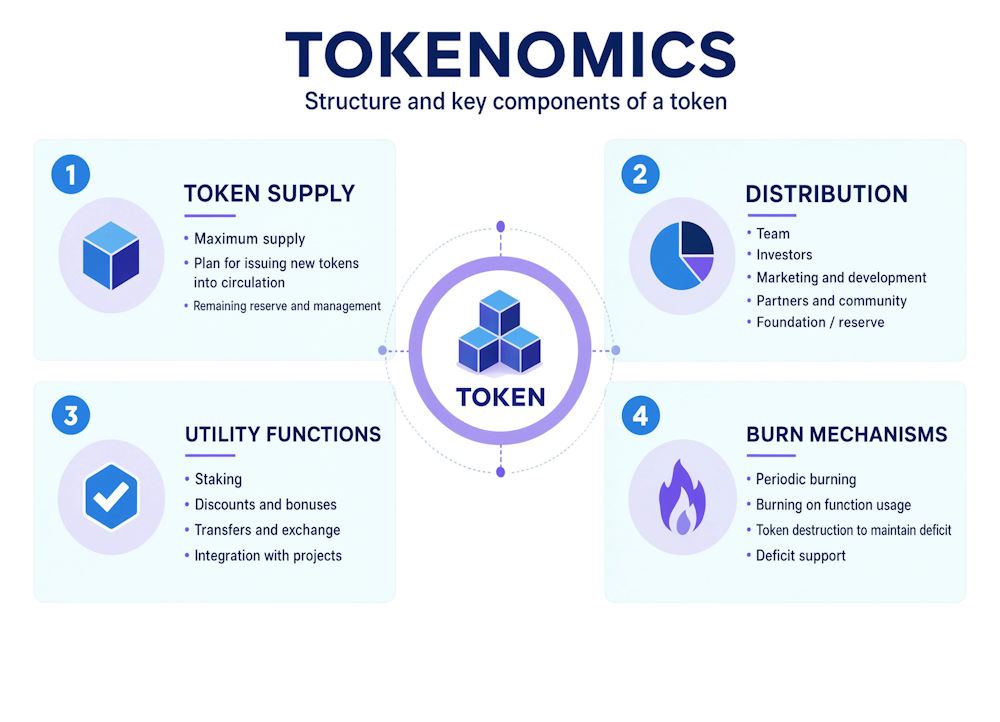
Tokenomics (from the words "token" and "economics") is the economic model of a specific cryptocurrency/crypto project, a set of rules defining the mechanism of creation and burning, distribution, and use of that cryptocurrency.
- Key elements: supply (max, circulating), distribution, utility, incentive mechanisms, burning and issuance of new tokens.
- Tokenomics analysis helps assess a project's long-term prospects and avoid investment traps.
- Good tokenomics, without obvious bias in anyone's favor, balances the interests of the development team, investors, and the community.
Why tokenomics matters for an investor
Imagine two companies:
- Company A: issued 100 shares, all in circulation, the business is profitable
- Company B: issued 1 million shares, but 90% belong to the founders and will be sold within a year
Both companies may have the same technology, but their investment attractiveness differs radically. The same applies to crypto projects: even brilliant technology will not save a project with a failed economic model.
Key questions that tokenomics analysis answers:
- How many tokens exist now and how many will there be in the future?
- Who owns the tokens and when will they be able to sell them?
- Why are tokens needed, other than for speculation?
- What mechanisms support or destroy value?
Key elements of tokenomics
The economic model of any cryptocurrency is built on four pillars: supply, distribution, utility, and incentives. Let's examine each element in detail.
1. Token supply: types and meanings
In tokenomics, there are three key supply metrics that are often confused:
| Metric | Definition | Example (Bitcoin) | Why it matters |
|---|---|---|---|
| Max Supply | Absolute limit of tokens that will ever exist | 21,000,000 BTC | Determines the scarcity of the asset |
| Circulating Supply | Number of tokens freely in circulation right now | ~19,700,000 BTC (as of 2026) | Affects the current market capitalization |
| Total Supply | All tokens created, including locked and lost ones | ~19,700,000 BTC | Shows the real issuance |
Important nuance: not all projects have a max supply. Bitcoin, Bitcoin Cash, and Litecoin are capped, while Ethereum, Dogecoin, and Polkadot can issue new tokens indefinitely. This does not automatically make them worse — it all depends on burning mechanisms and real demand.
Inflationary and deflationary models
Inflationary model — supply grows over time. Example: Dogecoin issues about 5 billion new coins annually. This is similar to fiat currencies, where constant issuance reduces purchasing power.
Deflationary model — supply shrinks or grows slower than demand. Example: after the EIP-1559 upgrade, Ethereum burns part of transaction fees. Under high network load, more ETH is burned than issued, making ether a deflationary asset.
Hybrid model — a combination of both approaches. Example: BNB regularly burns tokens, but the initial supply was large (200 million), so the deflation process takes years.
2. Token distribution: who owns and when they sell
How tokens are distributed at a project's launch critically affects its decentralization and price stability.
Types of distribution
Fair launch
- Tokens become available to everyone simultaneously
- No private sales, no pre-mining
- Examples: Bitcoin, Dogecoin
- Pros: high decentralization, fairness
- Cons: hard to attract development funding
Pre-allocation (Pre-mine/Pre-sale)
- A portion of tokens is reserved for the team, investors, and funds
- Examples: Ethereum, Solana, most modern projects
- Pros: allows funding development
- Cons: risk of concentration, price pressure upon unlocks
Typical distribution structure of a modern project
| Category | Share | Purpose |
|---|---|---|
| Team and founders | 15-20% | Reward for developers |
| Early investors | 15-25% | Return on venture capital funds' investments |
| Community and ecosystem | 30-40% | Incentives for users, grants, airdrops |
| Treasury | 10-15% | Long-term project development |
| Public sale | 5-10% | Initial capital raising |
Red flags when analyzing distribution:
- Team and insiders own more than 40% of tokens
- More than 50% of supply is locked and will be unlocked within a year
- Lack of transparent distribution information
Vesting and unlock schedules
Vesting is a mechanism for gradually unlocking tokens. Instead of issuing all tokens at once, the project sets a schedule: for example, 25% after a year, then 6.25% each quarter.
Why it is needed:
- Prevents instant dump by the team
- Aligns incentives: developers are interested in long-term success
- Reduces price volatility
Where to find vesting schedules:
- Project documentation (whitepaper)
- CoinGecko, CoinMarketCap — "Market Info" sections
3. Token utility: why it is needed
A token without utility is just a speculative asset. The more real use cases, the more stable the demand.
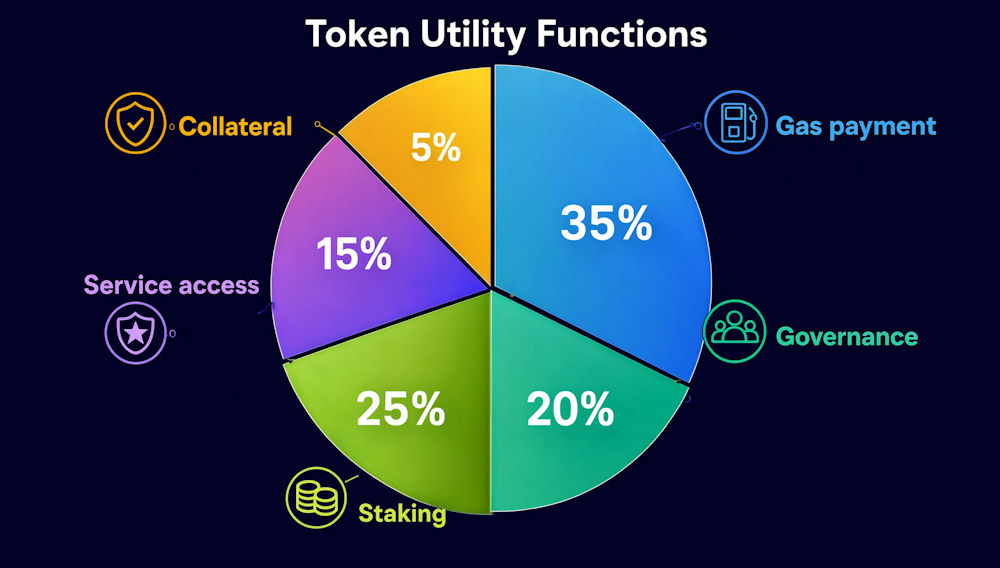
Main token functions
- Fee payment (Gas)
- Native blockchain tokens are used to pay for transactions
- Examples: ETH in Ethereum, SOL in Solana, BNB in BNB Chain
- The more active the network, the more demand for the token
- Governance
- Staking and network security
- Tokens are locked to validate transactions (Proof-of-Stake)
- Validators receive a reward but risk losing their stake in case of fraud
- Examples: ETH 2.0, ADA (Cardano), DOT (Polkadot)
- Access to services
- Tokens grant the right to use certain platform features
- Examples: BNB for reduced fees on Binance, MKR for managing MakerDAO
- Collateral
- Tokens are used as collateral in DeFi protocols
- Examples: AAVE, Compound, MakerDAO
- Discounts and privileges
- Holders get reduced fees or exclusive access
- Examples: BNB (discounts on Binance)
4. Incentive mechanisms: how the network attracts participants
Blockchain networks require constant user participation for security and development. Tokenomics creates economic incentives for this participation.
- Mining (Proof-of-Work)
- Miners receive new tokens and fees for creating blocks
- Example: Bitcoin (3.125 BTC per block after the 2024 halving)
- Pros: proven security, decentralization
- Cons: high energy consumption, barrier to entry (equipment needed)
- Staking (Proof-of-Stake)
- Validators lock tokens and receive a reward for confirming transactions
- Example: Ethereum (yield ~3-5% annually)
- Pros: energy efficiency, accessibility
- Cons: risk of centralization among large holders
- Liquidity pools
- Users provide tokens to DeFi pools and receive a reward
- Example: Uniswap, PancakeSwap
- Risk: Impermanent loss
- Airdrops and retroactive rewards
- Free distribution of tokens to active users
- Examples: Uniswap (400 UNI to each user), Arbitrum, Optimism
- Goal: decentralization of distribution, user acquisition
Supply control mechanisms
Tokenomics developers use various tools to balance supply and demand.
Token burning (Token Burn)
Burning is the irreversible removal of tokens from circulation. Tokens are sent to an address from which transactions are impossible (burn address).
Types of burning
| Type | Description | Example |
|---|---|---|
| Regular (scheduled) | Burning at fixed intervals | BNB (quarterly burn) |
| Transactional | Part of the fees is burned on every transaction | Ethereum (EIP-1559) |
| Dynamic | Burn volume depends on market conditions | Safemoon (and other meme coins) |
Burning math:
If a project burns 2% of supply annually while inflation is 5%, net inflation = 5% - 2% = 3%.
Criticism of burning:
- Often used as a marketing gimmick without real value
- Can mask high inflation
- Does not create fundamental value (unlike share buybacks in traditional companies)
Halving
Halving is a programmed reduction of the block creation reward by half at set intervals.
Bitcoin:
- Initial reward: 50 BTC per block
- After 1st halving (2012): 25 BTC
- After 2nd (2016): 12.5 BTC
- After 3rd (2020): 6.25 BTC
- After 4th (2024): 3.125 BTC
- Last halving: ~year 2140
Halving effect:
- Slows down inflation
- Historically preceded bull markets (but correlation does not imply causation)
- Creates scarcity
Other projects with halving:
- Litecoin (every 4 years)
- Bitcoin Cash (similar to Bitcoin)
- Dash (every ~21 months)
Elastic supply
Some projects use algorithmic supply changes depending on price.
Example: Ampleforth (AMPL)
- If the price is above the target ($1), supply increases
- If the price is below, supply decreases
Goal: price stabilization without a fiat peg
Problem: difficult to understand, short-term volatility
Tokenomics math: formulas and calculations
Understanding the basic formulas helps assess a project's real value.
Market capitalization (Market Cap)
Example:
- ETH price: $3,000
- Circulating supply: 120 million ETH
- Market capitalization = $3,000 × 120,000,000 = $360 billion
Important: Market capitalization shows the project's current value but does not account for future unlocks.
Fully diluted valuation (FDV)
Example:
- SOL price: $150
- Max supply: 500 million SOL
- FDV = $150 × 500,000,000 = $75 billion
Why FDV matters:
If Market capitalization = $10 billion and FDV = $100 billion, only 10% of tokens are in circulation. The remaining 90% will be unlocked, creating downward pressure on the price.
Rule: The Market capitalization / FDV ratio should be at least 0.3-0.5 for healthy projects.
Token inflation
Example:
- Circulating supply: 100 million tokens
- Annual issuance: 5 million tokens
- Inflation = (5,000,000 / 100,000,000) × 100% = 5%
Comparison with traditional assets:
- Bitcoin (2024): ~0.8% (after halving)
- Ethereum (2024): ~0.5-1% (depends on network load)
- US Dollar (2023): ~3-4%
- Dogecoin: ~4% (fixed issuance)
Team and insider share
Recommended values:
- Healthy tokenomics: 20-35%
- Moderate risk: 35-50%
- High risk: over 50%
Tokenomics examples: successful and failed models
Successful examples
Bitcoin (BTC)
- Max supply: 21 million (hard cap)
- Distribution: fair launch, no pre-mine
- Utility: "digital gold", medium of exchange
- Incentives: mining, halving every 4 years
- Why it works: predictability, scarcity, decentralization
Ethereum (ETH)
- Max supply: none (but deflationary under high load)
- Distribution: pre-mine (ICO 2014), but with vesting
- Utility: gas for smart contracts, staking, collateral in DeFi
- Incentives: staking (3-5% annually), fee burning
- Why it works: versatility, the decentralized application ecosystem, transition to PoS (Proof of Stake)
BNB (BNB)
- Max supply: 200 million (initially), decreasing
- Distribution: sold to investors and team
- Utility: discounts on Binance, gas in BNB Chain, participation in Binance Launchpad
- Incentives: quarterly burn, staking
- Why it works: real utility, regular burning, the Binance ecosystem
Failed examples
Stepn (GMT)
- Problem: pyramidal structure — users earned tokens to buy sneakers for even more token mining
- Result: hyperinflation, 99% price drop, project shutdown
- Lesson: tokenomics should create real value, not infinite issuance
Worldcoin (WLD)
- Problem: at launch only 1% of tokens were in circulation, the team controlled 99%
- Result: price manipulation, artificial scarcity, volatility
- Lesson: opaque distribution is a red flag
Terra (LUNA) — before the collapse
- Problem: algorithmic stablecoin UST without real backing
- Result: total collapse, token wiped out, $40 billion in losses
- Lesson: algorithmic stablecoins are high risk
How to analyze tokenomics: step-by-step guide
Step 1: Study the documentation
- Whitepaper (project technical document)
- The "About" or "Tokenomics" page on the official website
- Project blog (updates on burning, vesting)
Step 2: Check the supply
- Max supply (is there a cap?)
- Circulating supply (how much is in circulation?)
- Market cap / FDV ratio
Step 3: Analyze the distribution
- Share held by team and insiders
- Vesting schedules (when are unlocks?)
- Decentralization (top holder wallets)
Step 4: Assess utility
- Why is the token needed besides speculation?
- Is there real demand?
- Does demand depend on ecosystem growth?
Step 5: Study the incentives
- How are users attracted?
- Are the rewards sustainable?
- Are there burning or buyback mechanisms?
Tools for analysis
| Tool | What it shows |
|---|---|
| CoinMarketCap.com / CoinGecko.com | Analytics platforms: market cap, circulating supply, trading volume, and more |
| DefiLlama.com | Analytics platform for DeFi: TVL, protocol yields, stablecoins |
| OKLink.com | Multi-blockchain explorer by OKX: Bitcoin, Ethereum, BSC, Solana, TRON, and other networks (available in Russian) |
| Blockchain.com Explorer | Universal explorer for Bitcoin, Ethereum, and other networks |
| Etherscan.io | Explorer for the Ethereum network (ERC-20 tokens, transactions, smart contracts) |
| BscScan.com | Explorer for BNB Smart Chain (BEP-20 tokens, transactions) |
| Solscan.io | Explorer for the Solana network (SPL tokens, NFTs, transactions) |
| TronScan.org | Explorer for the TRON network (TRC-10/TRC-20 tokens, transactions) |
| Polygonscan.com | Explorer for the Polygon network (tokens, transactions, smart contracts) |
| Snowtrace.io | Explorer for Avalanche C-Chain (transactions, tokens, contracts) |
| Arbiscan.io | Explorer for the Arbitrum One network (L2 transactions, tokens) |
Evolution of tokenomics: from Bitcoin to Web3
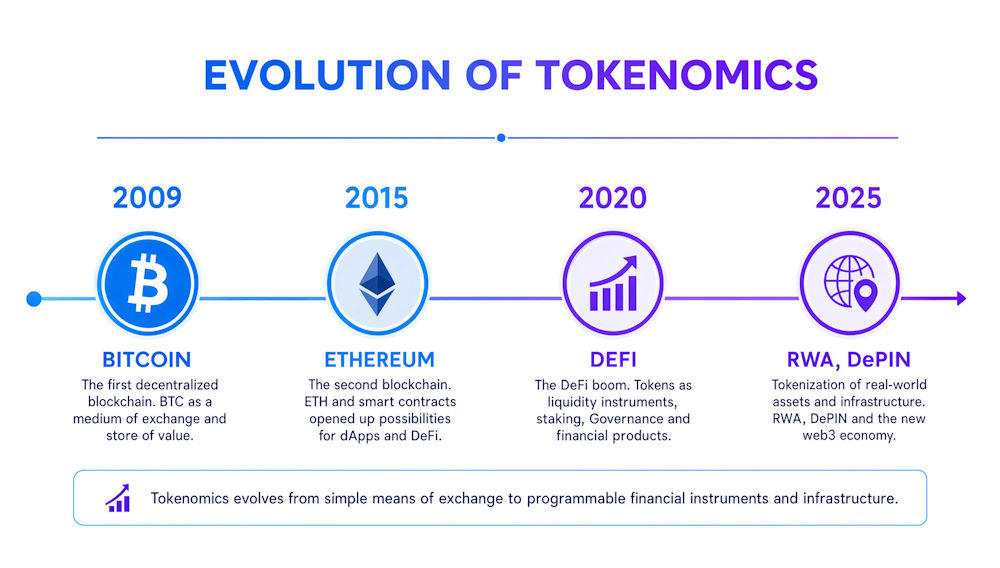
Generation 1: Simple models (2009-2015)
- Bitcoin: fixed supply, mining, halving
- Litecoin, Dogecoin: variations of the Bitcoin model
- Focus: "digital gold", medium of exchange
Generation 2: Smart contracts (2015-2020)
- Ethereum: gas for smart contracts, ICO boom
- ERC-20 tokens: standardization, explosive project growth
- Focus: utility, access to services
Generation 3: DeFi and governance (2020-2022)
- UNI, COMP, AAVE: governance tokens, yield farming
- Staking: Ethereum's transition to PoS
- Focus: decentralized governance, yield
Generation 4: RWA and specialization (2023-2026)
- Tokenization of real-world assets: real estate, bonds, commodities
- DePIN: rewards for physical infrastructure (Helium, Filecoin)
- GameFi: two-token models (utility + governance)
- Focus: integration with traditional finance, real value
Regulatory aspects of tokenomics
As the crypto industry grows, regulators are paying more attention to projects' economic models.
Security tokens
If a token passes the Howey Test, it may be recognized as a security:
- Investment of money
- In a common enterprise
- With an expectation of profit
- Derived from the efforts of others
Examples: 2017 ICO tokens, some DeFi tokens
Consequences:
- Need to register with the SEC (US) or similar bodies
- Restrictions for retail investors
- Increased disclosure requirements
Stablecoins
Stablecoins (USDT, USDC, DAI) require special regulation:
- Centralized (USDT, USDC): require reserves, audit
- Decentralized (DAI): require transparency of backing algorithms
Trend: MiCA (Markets in Crypto-Assets) in the EU — comprehensive regulation since 2024
Future of tokenomics
Trends 2025-2030
1. Integration with traditional finance
- Tokenized bonds, stocks, real estate
- Institutional investors demand compliance
2. Dynamic tokenomics
- Algorithmic adaptation to market conditions
- AI-driven supply management
3. Real yield
- Abandoning token issuance for rewards
- Yield from real protocol fees
4. Modular blockchains
- Separation of layers (execution, settlement, data availability)
- Specialized tokens for each layer
5. Decentralized identity
- Tokens as identity verification
- Soulbound tokens (non-transferable tokens)
Frequently asked questions (FAQ)
Tokenomics is the set of economic rules of a cryptocurrency: how many tokens will be issued, how they are distributed, why they are needed, and how their value is maintained.
Tokenomics is the economic model of a specific token. Crypto-economics is a broader concept that includes the economic incentives of the entire blockchain network.
No. Tokenomics is a necessary but not sufficient factor. Technology, team, market conditions, and competition also matter.
FDV (Fully Diluted Valuation) is the fully diluted valuation that takes into account all tokens, including locked ones. If FDV is much higher than Market Cap, there will be unlocks that can significantly drive the price down.
Use online tools, for example https://dropstab.com/ru/vesting or https://cryptorank.io/ru/token-unlock, and study the project's public information. There you should find vesting schedules for the team, investors, and ecosystem.
It depends on the context. Deflationary creates scarcity but can limit usage. Inflationary encourages spending but reduces value. Balance matters more than extremes.
Yes. Even if a project does not issue a token, it uses the network's native coin (ETH for Ethereum, SOL for Solana). The economic model is always present.
Conclusion
Tokenomics is the foundation on which a cryptocurrency's long-term value is built. Understanding a project's economic mechanisms helps separate sustainable models from speculative bubbles.
Key takeaways:
- Analyze not only the technology but also the token's economics
- Pay attention to distribution and unlock schedules
- Assess real utility, not promises
- Use Market capitalization and FDV formulas to value the project
- Avoid projects with opaque or pyramidal structures
Remember: even the most brilliant technology will not save a project with failed tokenomics. And conversely — moderate technology with a well-designed economic model can succeed.
Disclaimer
This article is for informational and educational purposes only, may become outdated, and may contain errors and inaccuracies. It is not financial advice, an invitation to act, or professional consultation. Always do your own research and consult with independent specialists. Cryptocurrencies and investing carry the risk of a complete loss of invested funds; returns are not guaranteed.