What Is Cryptocurrency? Origin Story, How to Buy, and Future Prospects
Published: 30.03.2026 • Updated: 06.08.2026 • Author: Fedor Sokolovskiy
- Cryptocurrency Is a Digital Means of Payment
- Technology: Blockchain as a Shared Database
- The Origin of Cryptocurrency
- Why Bitcoin Has Value
- Types of Cryptocurrencies
- Stablecoins — Stability or Illusion?
- Where and How to Store Cryptocurrency
- How to Buy Crypto in 2026
- Risks Not Mentioned in the Ads
- A Brief Guide for Beginners (If You Decide to Try)
I have been involved in crypto for several years now, and I decided to write an article about what cryptocurrency actually is, because not everyone knows (and that is perfectly normal). At first I started purely with technical terms, then decided to dig into the history and study everything thoroughly — partly to close my own knowledge gaps. It turned into a long read that covers both theory and practice.
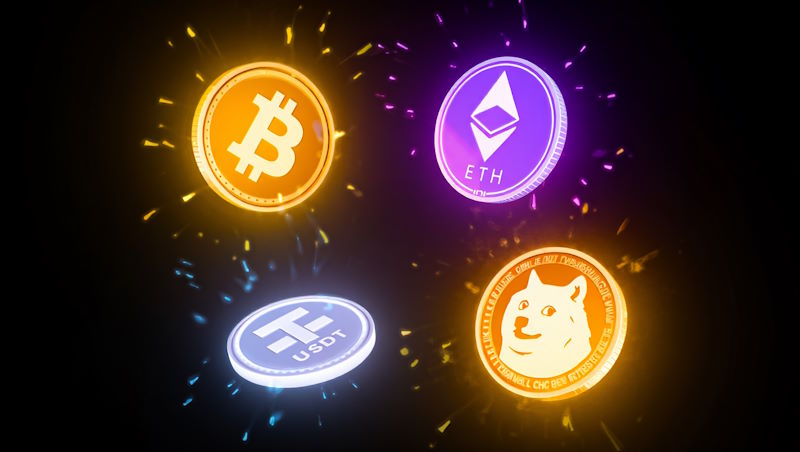
Cryptocurrency Is a Digital Means of Payment
The most important difference between crypto and fiat (regular money like the ruble or the dollar) is that it is decentralized — there is no single controlling authority. No state, bank, or specific individual controls the issuance of new coins or can freeze your account. Everything runs on mathematical algorithms and is maintained by a network of voluntary participants. Information about transactions and wallet balances is stored in the blockchain simultaneously across millions of computers around the world.
Another important feature I would highlight is that cryptocurrency transactions are irreversible. Always, without exception. A transfer cannot be canceled technically. Likewise, if you accidentally send a payment to a non-existent address, the funds will be lost permanently. That is why you must be extremely careful when transferring and always double-check recipient addresses.
Technology: Blockchain as a Shared Database
Cryptocurrency is built on blockchain technology. Imagine a database or a huge ledger in which every transaction ever made is stored. If I change one entry (that is, make a transaction), all network participants see that change, and the history cannot be tampered with. Every action is recorded in a chain that is stored simultaneously on millions of participants. These are the very "network confirmations" that must take place with every transaction.
The blockchain is that very chain of blocks containing records of transfers. It cannot be forged, because doing so would require rewriting the data on all the computers in the network at once. There are thousands of them, located in different countries. This makes the system highly resistant to hacking.
The Origin of Cryptocurrency
Cryptocurrency did not appear out of nowhere. It had predecessors that provided the technical groundwork and set the direction of blockchain technology's development.
Predecessors: eCash, b-money, and bit gold
The idea of digital money appeared long before Bitcoin. As early as 1983, American cryptographer David Chaum developed the "electronic cash" protocol (eCash), which enabled anonymous payments. His company DigiCash launched such a system in the 1990s, but the project failed. One of the main reasons is considered to be that the system was centralized and depended on partner banks.
In the late 1990s and early 2000s, conceptual works appeared that laid the foundation for Bitcoin:
- b-money (1998) — a proposal by programmer Wei Dai for an anonymous distributed electronic cash system.
- bit gold (1998–2005) — Nick Szabo's project, describing a digital asset that is "mined" by solving computational tasks (proof-of-work). In essence, this was a prototype of mining. That is why bit gold can be considered a direct predecessor of Bitcoin.
October 31, 2008: Satoshi Nakamoto
At that time, the global financial crisis was raging. And then an article appeared under the authorship of one Satoshi Nakamoto titled "Bitcoin: A Peer-to-Peer Electronic Cash System". It was the first time a blockchain technology with a proof-of-work mechanism was proposed. Whether it is one person or a whole team of developers remains unknown. Still, experts tend to believe it was a team of top-class specialists.
January 3, 2009: The Launch of Bitcoin
That was when the network was launched and the so-called genesis block (the first block of the BTC blockchain) was generated. Embedded in the block was an easter egg — a headline from The Times: "Chancellor on brink of second bailout for banks". Since a banking crisis was raging at the time, this easter egg was perceived as a political manifesto and an indication of why a decentralized currency is needed.
On January 12, 2009, the first transaction took place: Satoshi sent 10 BTC to the wallet of one of the developers, Hal Finney. Finney himself mined bitcoins on his personal computer and later became a key member of the community.

May 22, 2010: First Purchase with Crypto and Bitcoin Pizza Day
The first purchase made with BTC was... a pizza. A programmer from Florida, Laszlo Hanyecz, wrote on the Bitcoin Talk forum that he would pay 10,000 BTC to anyone who ordered two pizzas to his address. The deal went through: the pizzas from Papa John's cost Laszlo roughly $30–40 at the then exchange rate. How much that is today you can calculate yourself…
Since then, this day has been celebrated as Bitcoin Pizza Day. In interviews, Laszlo himself said he did not regret the deal: "I just wanted to prove that these internet money could be exchanged for something real. It was a real milestone."
The Disappearance of Satoshi
By 2011, Satoshi Nakamoto had gradually stopped communicating with the community. His last known message was sent to developer Mike Hearn in April 2011: "I am working on other projects. The code is in good hands."
Since then, there have been no confirmed messages from the creator of Bitcoin. Approximately 1.1 million BTC mined in the first months (the so-called Satoshi-era coins) have never been moved. If these really are his wallets, and he has access to them, he has most likely deliberately chosen not to use them — otherwise he would crash the market.
Why did he leave? There are many versions:
- To preserve decentralization (Bitcoin should have no leader).
- To avoid legal pressure.
- Possibly something happened — he is ill or no longer alive.
No one knows for sure. That is the mystery.

Key Milestones of Further Development
- 2013–2017: Bitcoin attracts the attention of the first investors, crypto exchanges are created, and the first major hacks and scandals occur.
- 2021: Bitcoin became legal tender in El Salvador, which became the first country to recognize cryptocurrency as a means of payment.
- 2024: Spot Bitcoin ETFs were approved in the United States, making the asset accessible to institutional investors.
- 2025: Bitcoin set a new all-time high, surpassing $125,000.
Why Bitcoin Has Value
Because people believe in its value, and this concept is far from new. Gold is valuable because it is scarce and people have agreed that it is valuable. National currency is valued because it is accepted as a means of payment and you can buy goods with it. Wild tribes valued rare shells for the same purpose.
Bitcoin also has a hard cap: the code dictates that there will be a total of 21 million coins. For reference — as of August 2025, 19.91 million bitcoins had been mined, which is almost 95% of the possible maximum. No one can simply issue new ones, like turning on a printing press. At the same time, part of the coins is already lost irretrievably: people forgot wallet passwords, died without leaving access to heirs, or threw away old computers and smartphones with wallets. By some estimates, about 3–4 million BTC have been permanently lost. This creates additional scarcity and increases the asset's value.
But let us not idealize it. The crypto market remains one of the most volatile and manipulated spheres. And that is its nature at the moment — susceptibility to manipulation. So it is too early to treat crypto as a reliable safe-haven asset. Rather, it is a high-risk speculative asset. Or a means for fast payments with minimal fees, bypassing bank blockages and sanctions.
Types of Cryptocurrencies
The crypto world contains several main types of assets:
- Bitcoin (BTC) — the first cryptocurrency, "digital gold." It has high transaction fees, and transactions can take a long time. As a means of payment for small transfers, it is now practically useless. But it is Bitcoin that is considered the number one investment instrument. It is also called the "lead dog" — because almost all altcoins move with it: if Bitcoin goes up, altcoins most often go up too; if Bitcoin falls, altcoins fall even harder.
- Altcoins — all other cryptocurrencies that have their own blockchain (for example, Ethereum, Solana, Litecoin).
- Tokens — digital assets that do not have their own blockchain but are created on top of existing ones (for example, ERC-20 standard tokens on the Ethereum network). They are often used in various projects.
- Stablecoins (USDT, USDC, DAI) — a cryptocurrency whose price is pegged to the US dollar at a 1:1 ratio. For example, 1 USDT should always equal about 1 USD. Sold Bitcoin or some altcoin for USDT — and your money is insured against sharp exchange rate swings.
Stablecoins — Stability or Illusion?
Stablecoins are a critically important element of the crypto economy, but they are more complicated than they seem.
USDT (Tether) — the largest stablecoin with a capitalization of about $183.6 billion. According to recent reports, Tether's reserves total about $181 billion against liabilities of $174.45 billion, meaning there is formally a small surplus. The bulk of the reserves are US government bonds ($135 billion), but there are also investments in gold ($12.9 billion) and even in Bitcoin ($9.9 billion).
And this is where the problems begin. Critics, including BitMEX co-founder Arthur Hayes, point out: if Bitcoin and gold simultaneously fall in price by 30% (which is a quite realistic scenario), Tether's losses would amount to about $6.84 billion, which would almost entirely wipe out its surplus buffer. In that case, the stablecoin's backing could become insufficient.
Moreover, in 2021 there was a high-profile scandal: the CFTC (US Commodity Futures Trading Commission) fined Tether $41 million for false or misleading statements that this cryptocurrency was supposedly fully backed by dollars. And although in 2026 the company received its first audit from Deloitte (for the new USAT stablecoin, not for USDT), this is still not a full financial audit of all operations, but merely confirmation of the availability of funds on a specific date.
USDC from Circle is considered more transparent — the company has regularly published audit reports since 2023. But it is not immune to problems either: in March 2023, USDC temporarily lost its dollar peg due to the crisis at Silicon Valley Bank, where the company held reserves.
The main risk of any stablecoin is loss of the dollar peg (depeg). The most notorious case is the collapse of the algorithmic stablecoin UST in 2022, which dragged down the entire Terra ecosystem worth tens of billions of dollars. It was a huge blow to the entire crypto industry and severely undermined investor confidence.
By 2026, regulation had tightened: the EU has the MiCA regulation in force, and the US has passed the GENIUS Act. Stablecoins are increasingly viewed as part of the global payment infrastructure. Checks, limits, and transparency requirements will only grow. But it is important to understand: a stablecoin is also a cryptocurrency, and it can be subject to the same force majeure as other coins, albeit to a lesser extent.
Where and How to Store Cryptocurrency
Storing crypto comes down to one principle: whoever holds the private key (aka the seed phrase) is the owner. A private key is a long code that, for the user's convenience, is usually written as 12–24 random English words. They are generated automatically when a wallet is created.
There are three main storage options:
- On an exchange. The simplest and most risky method. You buy coins, and they sit in the exchange's account. The exchange can be hacked, blocked by a regulator, have its license revoked, or go bankrupt (remember the FTX story). Only keep on an exchange the amounts you actively use for trading. In 2026, users increasingly expect platforms to provide not just promises, but real protective mechanisms and a fast response to incidents.
- In a software wallet. This is an app on your phone or a browser extension (MetaMask, Trust Wallet, and others). The keys are stored on your device, but the device itself is under threat of hacking, loss, or viruses. So this method is better suited for smaller amounts and active use (for example, for working with DeFi).
- In a hardware wallet. This is a separate physical device, similar to a USB drive. The best-known brands are Ledger, Trezor, OneKey. Private keys are generated and stored inside the device's secure chip and never leave it to go online. Even if you connect it to an infected computer, a hacker cannot steal the keys. For long-term storage of significant amounts, this option is considered the most reliable.
Important: according to crypto security rules, the seed phrase must not be stored in electronic form. No photos in the cloud, notes on the phone, screenshots, or files on the computer. You need to arrange the most reliable physical storage possible (paper, a metal plate in a safe) where no one but you can definitely gain access. Otherwise that person will be able to take all your funds.
How to Buy Crypto in 2026
Direct purchases with bank cards on international exchanges are now difficult due to sanctions, but there are working methods.
- P2P (peer-to-peer) on exchanges. Register on Bybit, HTX, OKX, or another major exchange that has a P2P marketplace. In the P2P section, choose a direction (for example, RUB → USDT). The system shows sellers with their ratings and deal terms. You transfer money to the seller by the chosen method (card, e-wallet), and after receiving it he transfers USDT to you. Important: strictly follow the exchange's instructions and do not go outside the platform to communicate and pay — there are a lot of scammers in this area.
P2P has legal nuances. In 2026, banks may link your fiat accounts to crypto wallets. And if you bought "dirty" cryptocurrency through P2P or a dubious exchanger and that crypto turned out to have been obtained illegally, your bank account could be frozen under Article 115-FZ, and all your accounts could end up blocked. And in some countries, such as Belarus, P2P is prohibited in principle. So P2P is very risky, especially since the laws are constantly changing and, as practice shows, in the direction of tightening.
- Exchangers via aggregators. On some aggregator site (for example, BestChange or another), you choose the needed exchange direction and see a list of exchangers with current rates and reserves. You go to the chosen exchanger's site, specify the amount and your wallet address, and pay. Here the same risks apply as with P2P — you need to choose proven exchangers with a good reputation and history, but even that does not guarantee the absence of problems in the future.
- Crypto ATMs. In some large cities there are physical terminals for buying and selling cryptocurrency. So far this method is underdeveloped and often offers an unfavorable rate, but the method has a right to exist.

Risks Not Mentioned in the Ads
Crypto is a high-risk sphere, and it is worth understanding the risks in advance.
- Volatility. The asset's price can fall by 30–50% in a single day. Matrixport analysts noted in February 2026 that capital outflows from stablecoins create a "notable obstacle" to Bitcoin's growth. Since the start of the year, the stablecoin supply has shrunk by $5.6 billion, and if the trend continues, Bitcoin will continue to experience a liquidity shortage.
- Regulatory risks. The use of cryptocurrency for internal settlements between residents in many countries (including Russia) remains prohibited. Legislation in this area changes very quickly, and what is allowed today may be banned tomorrow.
- Fraud. Thanks to high anonymity and often weak technical literacy of newcomers, the crypto sphere remains a favorable environment for scammers. They constantly invent new schemes: phishing sites, fake wallets, scam projects, counterfeit investment offers.
A Brief Guide for Beginners (If You Decide to Try)
- Learn the basics. Read a few articles, watch videos, so you clearly understand what a blockchain, a wallet, and a seed phrase are. Find out what risks exist and what the legal framework is in your country. Simply put, what you can and cannot do.
- Start small. Install a software wallet (for example, Trust Wallet or MetaMask). Carefully save the seed phrase in a safe place (on paper only!).
- Buy a small amount. Purchase USDT or BTC for an amount you would not mind losing (for example, the equivalent of $20–50).
- Try a transfer. Transfer coins from the exchange to your wallet and, if it works, back again. This will help you understand the mechanics of transactions, fees, and confirmation times.
- Do not chase quick profits. If you decide to invest, do not put in your last money or borrowed funds. Treat it as a high-risk investment.
- Ensure security. As soon as your amount becomes significant to you, be sure to get a hardware wallet for long-term storage.
Cryptocurrency is neither a panacea nor a way to get rich easily. It is simply a new class of assets and technologies that gives you more control over your money, but also demands much greater responsibility. If you approach it with a cool head, understand the basics, and do not fall for promises of "mountains of gold," it can be a useful tool in your financial arsenal.
I hope the article was useful and answered many of your questions. I understand it turned out very lengthy, but, believe me, I cut it down as much as I could. The whole detective story around Satoshi Nakamoto's identity alone is worth it — they could make a movie.
The following sources were used in this article:
- Cryptocurrency — Wikipedia
- Bitcoin — Wikipedia
- Satoshi Nakamoto — Wikipedia
- Binance Academy: what is Bitcoin
- The original Bitcoin whitepaper
- OKX: The rise and fall of Terra at $60 billion
- CFTC: $41 million fine for Tether
- GENIUS Act in the US, regulating stablecoins.
- EU's MiCA Regulation.
Disclaimer
This article is for informational and educational purposes only, may become outdated, and may contain errors and inaccuracies. It is not financial advice, an invitation to act, or professional consultation. Always do your own research and consult with independent specialists. Cryptocurrencies and investing carry the risk of a complete loss of invested funds; returns are not guaranteed.