What Is Bitcoin Halving and When Is the Next One
Published: 14.07.2026 • Updated: 06.08.2026 • Author: Fedor Sokolovskiy
- What Is Halving in Simple Terms
- How the Bitcoin Halving Mechanism Works
- Bitcoin Halving Dates: All-Time Table and Infographic
- How Halving Affects the Bitcoin Price
- First Halving
- Second Halving
- Third Halving
- Fourth Halving
- Miner Economics After the Reward Reduction
- When Is the Next Bitcoin Halving
- Halving in Other Cryptocurrencies
Halving (from the English "half" — dividing in half) is a twofold reduction of the mining reward for a coin. It is a significant event, so in this article we will examine the mechanics of the process and the date of the next halving of "digital gold" — Bitcoin. In short, the essence:
- Essence of the process: Halving is an automatic, blockchain-programmed reduction of the reward paid to miners for creating a new block, exactly by half. In other words, miners receive half the reward for the same amount of work.
- Frequency: Bitcoin's halving occurs strictly every 210,000 blocks, which is approximately 4 years.
- Current status: As of 2026, the last Bitcoin halving took place on April 20, 2024 (the reward dropped to 3.125 BTC). The next one is expected around spring 2028, but the exact time cannot be predicted, since mining speed varies and the halving is not tied to a calendar date — it is tied to block height and mining speed.
- Market impact: Such a sharp reduction in the emission rate of new coins is a serious stress for the market; however, the asset's price depends on a combination of macroeconomic factors, so it cannot be said definitively whether the halving will cause a sharp rise (or fall) in Bitcoin's value.
What Is Halving in Simple Terms
If you explain what halving in crypto means in simple terms, it is an event programmed into the code that cuts the issuance of new coins in half. Miners start receiving twice as few Bitcoins or other coins for their computational work. It is important to understand: halving does not withdraw existing coins from circulation, does not freeze accounts, and does not change the balances in users' wallets. It affects exclusively the rate at which new units of the asset appear.
This mechanism guarantees that the total number of Bitcoins will never exceed the hard cap of 21 million coins (Maximum Supply). Unlike fiat currencies, where a regulator can change the money supply at its discretion, Bitcoin's issuance follows strict mathematics, making it an asset with predictable, gradually decreasing inflation.
How the Bitcoin Halving Mechanism Works
The process works at the level of the underlying PoW (Proof-of-Work) consensus algorithm. Miners group unconfirmed transactions into blocks and solve a cryptographic puzzle. The one who finds the solution first adds the block to the blockchain and earns the right to include a special transaction in it that creates new coins and sends them to the miner's address as a reward.
The Bitcoin protocol contains a rule: every 210,000 blocks, the block reward is reduced by 50%. Since the average block creation time is algorithmically maintained at 10 minutes, 210,000 blocks are generated in about 1,458 days (roughly 4 years). If a miner tries to specify a reward in a block higher than the limit allowed by the protocol, the other nodes in the network will instantly reject that block as invalid. Thus, the rule is enforced in a decentralized way, without intermediaries.
Bitcoin Halving Dates: All-Time Table and Infographic
To see how halving events actually play out in practice rather than in theory, one must turn to historical data. Below is an infographic and a year-by-year table of Bitcoin halvings, reflecting the evolution of the reward and the market context at the time of each event.
| Event | Date | Block Height | Reward Before | Reward After | Price |
|---|---|---|---|---|---|
| BTC Launch | 03.01.2009 | 0 | - | 50 | $0 |
| 1st Halving | 28.11.2012 | 210 000 | 50 | 25 | ~$12 |
| 2nd Halving | 09.07.2016 | 420 000 | 25 | 12,5 | ~$650 |
| 3rd Halving | 11.05.2020 | 630 000 | 12,5 | 6,25 | ~$8 600 |
| 4th Halving | 20.04.2024 | 840 000 | 6,25 | 3,125 | ~$64 000 |
| 5th Halving (forecast) | ~Spring 2028 | 1 050 000 | 3,125 | 1,5625 | Unknown |
How Halving Affects the Bitcoin Price
Contrary to a common misconception, halving is not a reason for an instant rise in price. The mechanism of price influence is indirect and stretched over time. Analysts highlight several key factors:
- Falling supply: Daily issuance of new coins is cut in half. If investor demand stays the same or grows, the supply shortage puts upward pressure on the price. If overall demand falls, however, the halving may have a slight stabilizing effect on the price.
- Psychological factor and cyclicality: Anticipation of the event often creates bullish sentiment several weeks beforehand. Historically, however, the halving day itself is rarely accompanied by sharp price jumps. One can analyze past Bitcoin halvings on the chart.
First Halving
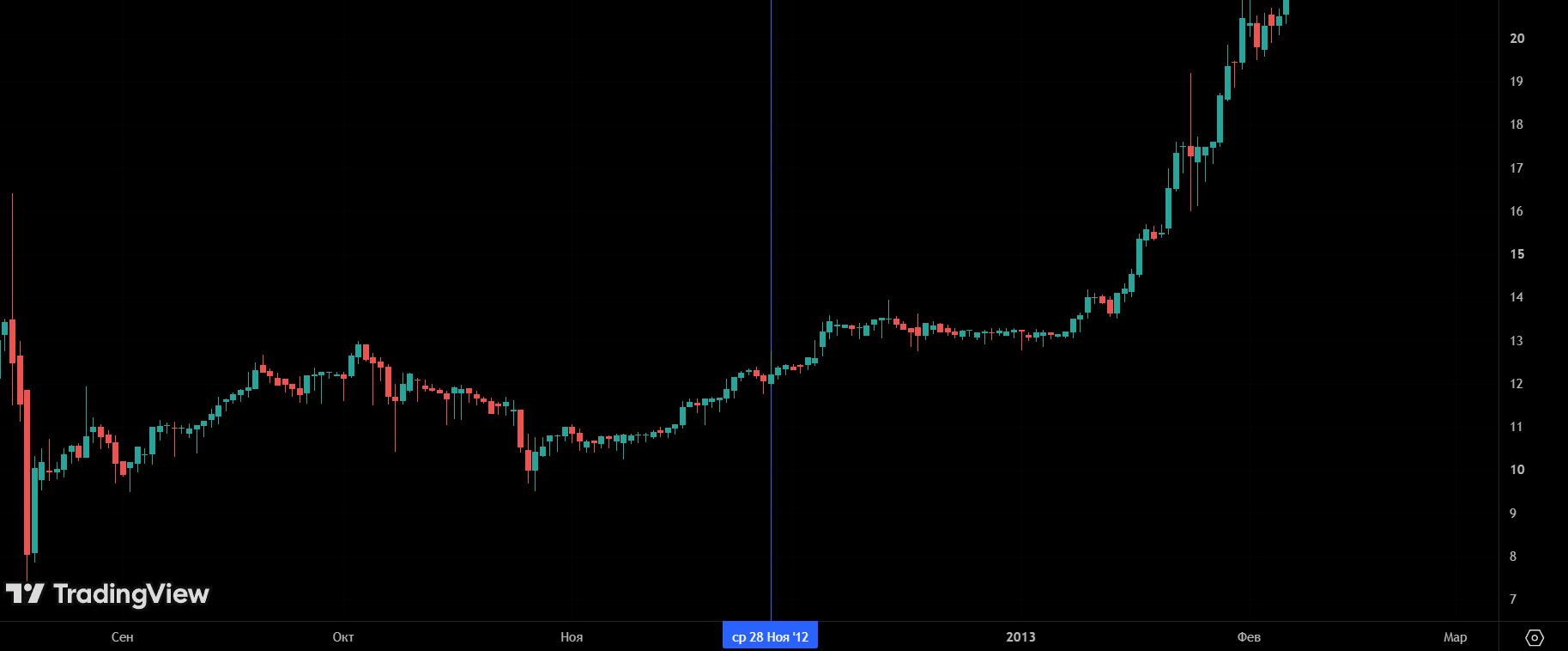
First halving (28.11.2012): the block reward dropped from 50 to 25 BTC. As you can see, the price barely reacted. Only more than a month later did growth occur, which is probably unrelated to the halving.
Second Halving
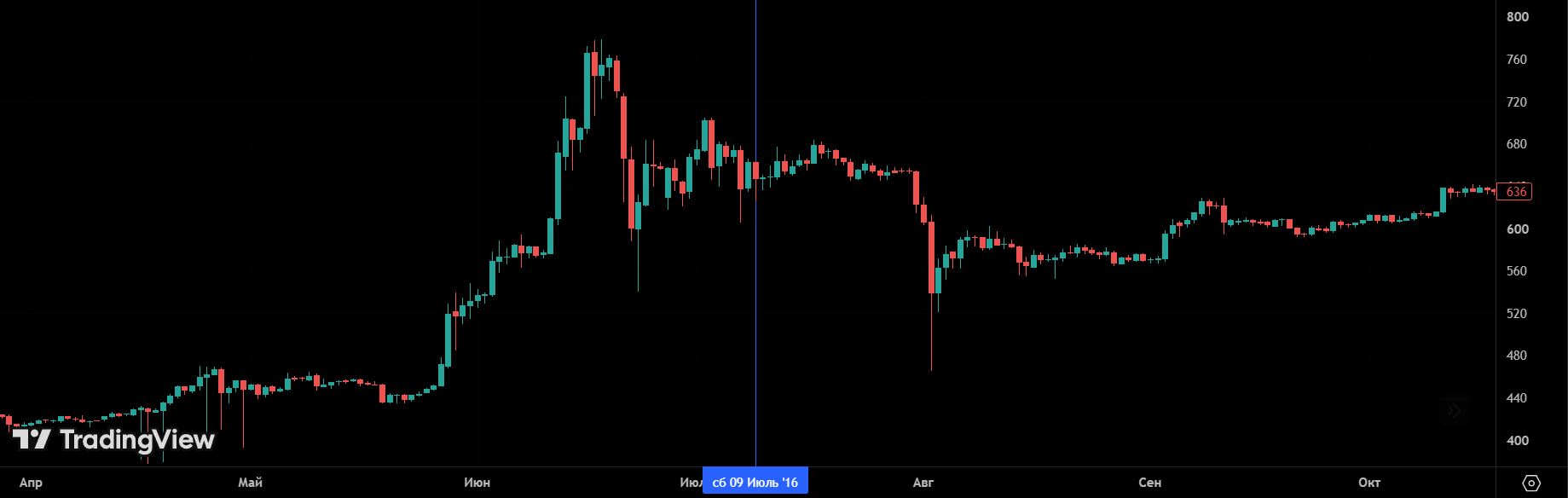
Second halving (09.07.2016): the block reward dropped from 25 to 12.5 BTC. The effect on the market is similar, except that a decline had already occurred, long after the event.
Third Halving
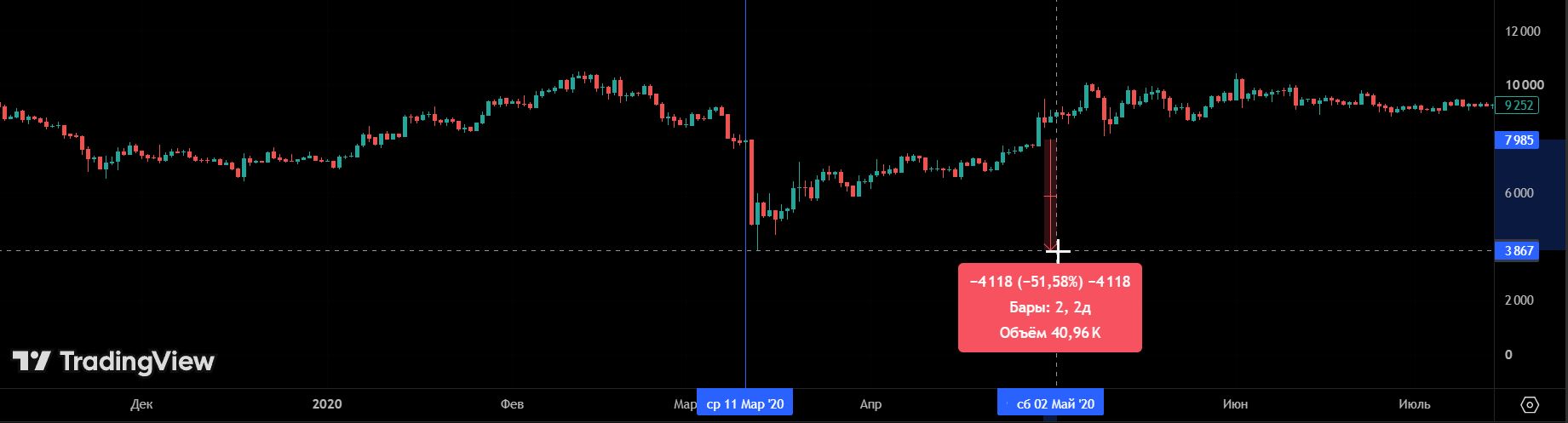
Third halving (11.05.2020): the block reward dropped from 12.5 to 6.25 BTC. The next day saw a significant drop — about 50%.
Fourth Halving
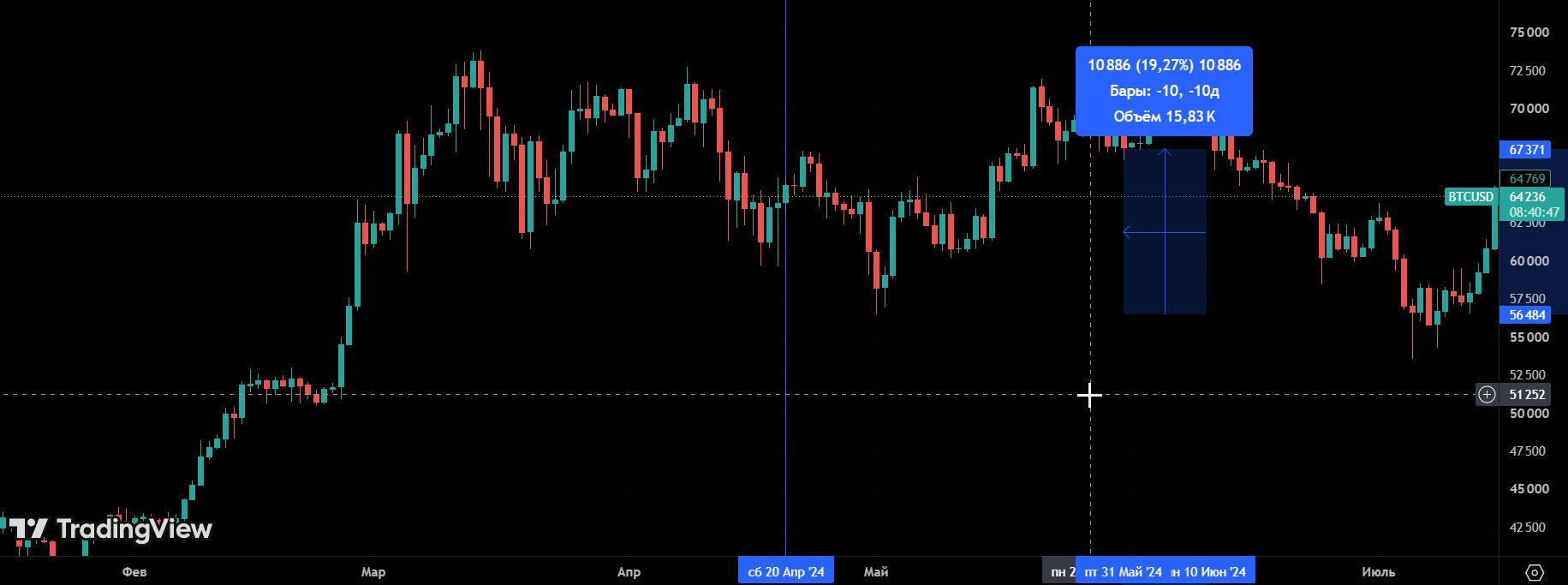
Fourth halving (20.04.2024): the block reward dropped from 6.25 to 3.125 BTC. It had no noticeable impact on the market.
As historical data shows, the blind belief that "Bitcoin always rises after a halving" is a dangerous misconception. It can both fall and not react at all. In other words, the correlation between halving and price movement appears random.
Miner Economics After the Reward Reduction
For miners, halving is a test of profitability. Their revenues drop by 50% instantly, while electricity and equipment depreciation costs remain the same. This leads to two predictable consequences:
- Shutdown of inefficient miners: Participants with high energy consumption and outdated equipment are forced to shut down, since mining becomes unprofitable for them.
- Automatic difficulty adjustment: The Bitcoin protocol recalculates mining difficulty every 2,016 blocks, which is roughly once every two weeks. If the hashrate drops due to miners shutting down, the difficulty decreases. This allows the remaining participants to find blocks more often and restore profitability, keeping the average block generation time at around 10 minutes.
When Is the Next Bitcoin Halving
People often wonder exactly when the 2026 halving will take place; let us answer this question by explaining the mechanics of the process. Halvings occur roughly every 4 years. Since the last event took place in April 2024, the next Bitcoin halving will occur around spring 2028 (upon reaching block height 1,050,000). No reward reduction will happen in 2026. The exact day of the 2028 halving cannot be named now, because the event is not tied to the calendar at all — it depends on the actual block generation speed in the network, which varies.
Halving in Other Cryptocurrencies
The halving mechanism is characteristic not only of Bitcoin but also of other PoW-based networks. It is important, however, to distinguish their architectures:
- Litecoin (LTC): It uses a similar model, but blocks are generated every 2.5 minutes. Therefore, Litecoin's halving occurs every 840,000 blocks (which also works out to roughly once every 4 years). The last LTC halving took place in August 2023, and the next one can be expected around August 2027.
- Ethereum (ETH): It is important to dispel a myth: Ethereum has no halving. After the transition to the Proof-of-Stake consensus algorithm (The Merge) and the introduction of the EIP-1559 standard, ETH issuance is regulated dynamically depending on network activity and fee burning. Sometimes the network becomes deflationary, but this is not a hard-coded halving event as in Bitcoin.
Frequently Asked Questions (FAQ)
It is an automatic reduction of the miners' reward for creating a new block, exactly by half. The event occurs every 210,000 blocks (about once every 4 years) to control inflation and ensure scarcity of the asset.
The last (fourth) halving occurred on April 20, 2024. The block reward dropped from 6.25 BTC to 3.125 BTC.
The next halving is expected in spring 2028, upon reaching block 1,050,000. The exact date is unknown, as it depends on the actual mining speed.
No. Ethereum moved to the Proof-of-Stake consensus algorithm, and it has no halving mechanism. ETH issuance is regulated dynamically and depends on network activity and fee burning (the EIP-1559 mechanism).
Halving reduces the rate at which new coins enter the market. Historically, this created the preconditions for price growth in the medium term (12–18 months later); however, the price also depends on macroeconomics, demand, regulation, and overall market sentiment. Therefore, it cannot be said that the price is guaranteed to rise after a halving.
No, this is a common misconception. Halvings occur every ~4 years. After the event in April 2024, the next one will only occur in 2028.
Disclaimer
This article is for informational and educational purposes only, may become outdated, and may contain errors and inaccuracies. It is not financial advice, an invitation to act, or professional consultation. Always do your own research and consult with independent specialists. Cryptocurrencies and investing carry the risk of a complete loss of invested funds; returns are not guaranteed.