What Is Funding in Trading
Published: 27.02.2026 • Updated: 14.09.2026 • Author: Fedor Sokolovskiy
In this article we take a detailed look at what funding is, why it is needed, and how it can be useful or dangerous for a trader. You will learn:
- What positive and negative funding are, and who pays whom.
- What determines the size of the rate and how often payouts occur.
- How the price-alignment mechanism works between spot and futures.
- Two strategies for profiting from funding: impulse and arbitrage.
- And most importantly — the pitfalls that beginners need to know about.
The article is written to be clear for those just starting to get acquainted with the crypto market; it includes examples and tables.
What Is Funding
Funding (from the English funding rate) is periodic payments between traders on the perpetual futures market. Holders of long positions pay holders of short positions — or vice versa.
This is not an exchange fee. The exchange acts only as an arbiter: it automatically deducts a percentage from some traders and credits others at a set interval — every 8, 4, or 1 hour.
The main goal of funding is to bring the futures price close to the price on the spot market (the market for the actual purchase of the coin). If, because of hype, prices diverge sharply, the funding mechanism helps align them. Without funding, the actual spot price of a coin could differ from the futures price by tens or even hundreds of percent, because there would be no price-alignment mechanism. The market simply could not function normally.
How it works in practice:
The percentage is deducted from the volume of your open position.
- Example: The rate is negative at -1.5%. You have an open short of 100 USDT. At the moment of payout, the exchange will deduct 1.5 USDT from you in favor of those holding longs.
- If, at the same rate, you had an open long of 100 USDT, you would have received 1.5 USDT instead of paying.
Important! The funding rate is constantly changing. Immediately before payout it can differ significantly from what it was, say, 30 minutes earlier. Always double-check the rate right before placing a trade.
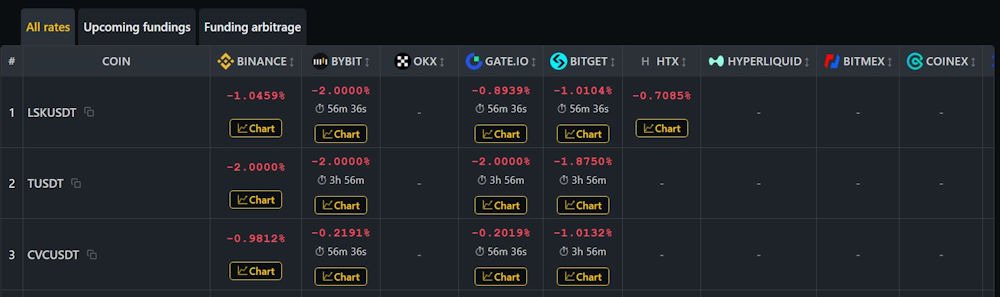
Types of Funding and Who Pays Whom
Funding can be positive or negative. There is a simple rule here that is easy to remember:
- Negative funding (-1%, -0.1%, etc.) → shorts pay longs. Holders of long positions profit.
- Positive funding (1%, 0.1%, etc.) → longs pay shorts. Holders of short positions profit.
If the rate is negative, those who sell (shorts) pay. If it is positive, those who buy (longs) pay.
What Determines the Funding Rate and Payout Frequency
The size of the rate directly depends on the size of the gap between the spot and futures prices.
- The larger the gap, the higher the rate.
- The rate can be zero, or it can reach 2–4% positive or negative. But extreme values (for example, 4%) do not last long — literally a few minutes — and fall quickly.
- In my observation, in the vast majority of cases the highest rates are negative (minus).
Payout frequency depends on the activity of the coin:
- Calm market: payouts every 8 hours.
- Active market: payouts can occur every hour to extinguish price gaps faster.
You can find out the exact frequency for a specific coin on the exchange itself — just open the futures chart. The timer is always there.

In the future, by user request, a countdown to the next funding may be added to our funding screener, but for now you can simply click the "Chart" button for the coin you are interested in and see everything directly on the exchange you want.
Why Funding Is Needed and How It Works
The task of funding is to remove the price gap between the spot and futures markets. The exchange does this very elegantly: it creates conditions under which the traders themselves start moving the price where it needs to go, using the funding rate.
Negative Funding: When Spot Outpaces Futures
Imagine: the spot price (the real price of the coin) is higher than the futures price. To pull the futures up, negative funding is introduced. And the larger the gap, the higher the rate and the more frequent the payouts.
- Traders see that they are paid to open and hold a long (since the rate is negative, longs receive the payout). They open long positions on futures, pushing the price up.
- Those already in shorts see the upcoming payout and do not want to lose money. They close their positions (closing a short = buying), which also pushes the price up.
- Some of those who would want to go short do not do so before negative funding.
- As a result, through the combined efforts of the traders themselves, the futures price is pulled toward the spot price and the gap disappears. And the conditions for such a reaction by traders were created by the exchange itself.
Positive Funding: When Futures Outpaces Spot
Here the mirror logic applies. The futures price is too high and needs to be pushed down. Positive funding is introduced (longs pay shorts).
- Longs do not want to pay and begin closing positions (closing a long = selling), pushing the price down.
- Shorts, on the contrary, see an opportunity to profit from payouts and open new short positions, also pushing the price down.
- The futures price falls, approaching the spot price.
Nothing complicated — you just need to understand this principle, and then everything becomes clear as day.
How Funding Is Charged or Credited
The process is fully automatic. At the appointed time (for example, 15:00) the exchange settles accounts to the millisecond (I verified this myself using trading bots on Binance and Bybit).
An important practical conclusion follows from this:
- If you close a position one second before funding (at 14:59:59), no funding will be charged to you.
- If you open a position one second before payout, you will either receive the payout or be charged — depending on the sign of the rate.
But do not rush to pop the champagne thinking you have found a way of guaranteed profit. There are many pitfalls, discussed below.
Funding Trading Strategies
I would divide profit strategies into two fundamentally different approaches: impulse (more risky) and arbitrage. Let's look at the pros and cons of each.
Impulse Strategy (Trading the Market Reaction)
This is a more risky strategy. It consists of trading the market's reaction to the funding rate. The thing is, at the moment of funding a price impulse occurs, sometimes significant. If the funding is negative — and in the vast majority the largest rates are negative — the impulse will be downward. And the larger the rate, the stronger the impulse. It is commonly believed that the size of the impulse is roughly equal to the percentage rate, i.e. for a 2% rate the impulse would also be about 2 percent, but in practice this is far from always the case.
Examples of my impulse funding trades: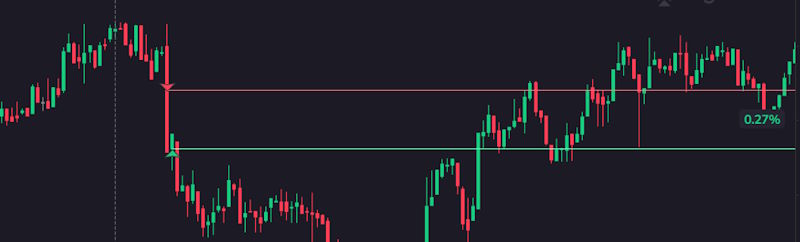
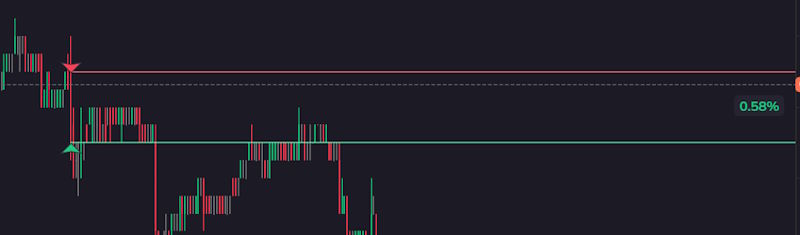
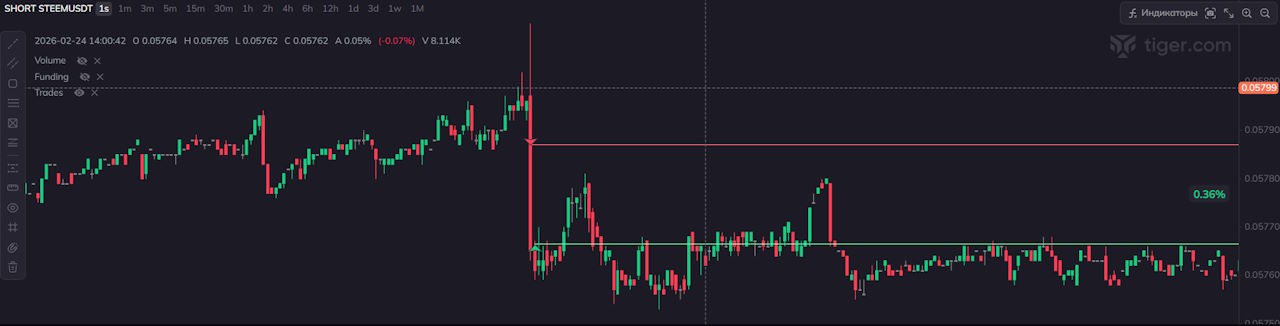
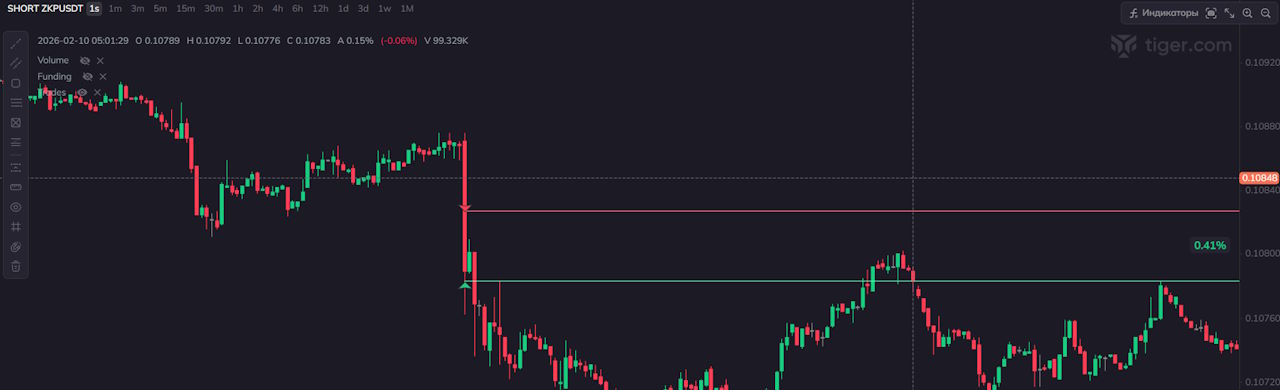
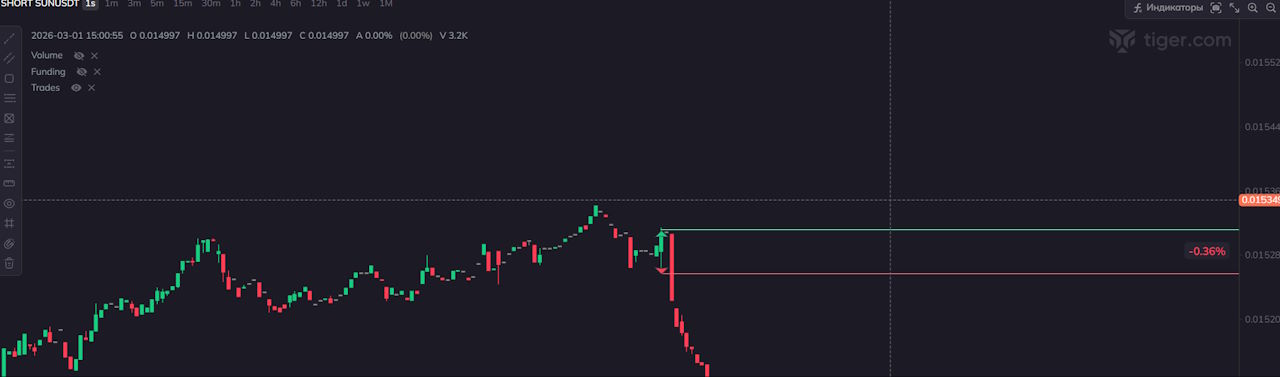
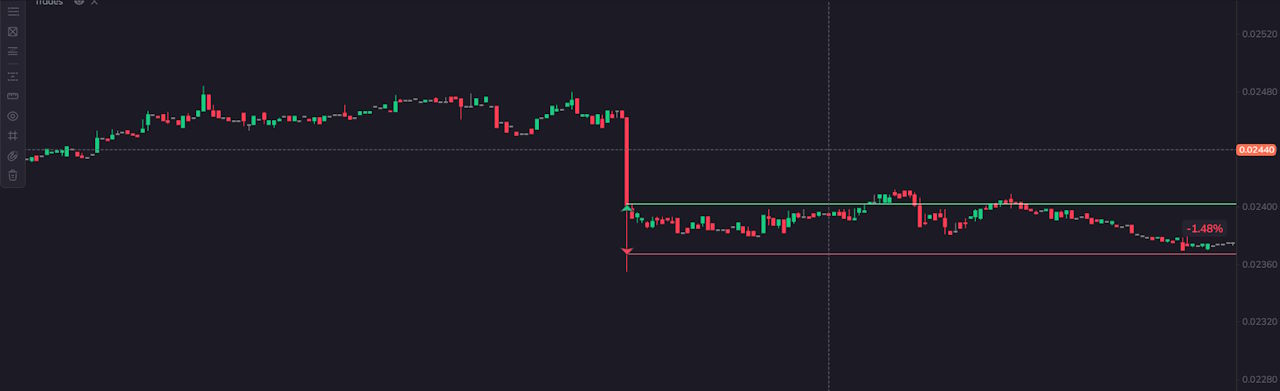
The impulse can be both weaker and significantly stronger. In my experience and observations, the probability of a strong impulse grows especially when the price is trading near a strong level or a cascade of levels, and the moment of the rate accrual acts as a trigger for breaking the level or cascade, activating participants' stop-losses and significantly amplifying the impulse. This can provide a mathematical edge and, even with a funding rate of, say, 1–2%, cause an impulse of 3–5% or more. This is quite possible on active coins where stop clusters sit behind the levels.
Let's look at the strategies using the example of a negative funding at 15:00. The impulse is traded in four ways:
- Entering the market directly at the moment of the impulse, immediately after the rate is credited/charged. That is, if the negative funding is at 15:00, we enter right at 15:00:00 expecting to catch the quick impulse and close in profit.
- Entering on the pullback after the impulse. Very often (but not always!) after the initial impulse there is a sharp price reversal back, and some traders may try to go long (in our example the impulse is short) in an attempt to catch this pullback.
- Mixed method — when the trader first goes "into the impulse" short, and then instead of simply closing the position after the impulse, flips to long, trying to capture that move as well.
- Entering in advance, paying the percentage rate in the expectation that the profit from the impulse itself will cover the loss from the rate charge. Here, in my view, it is necessary to apply the trick I mentioned earlier — see whether there are levels that the impulse could break and trigger the stops behind those levels. Then there really is a good chance that the profit will cover the paid rate and leave a solid gain.
It sounds simple, but of course there are serious downsides and pitfalls:
- No guarantees that the impulse will be strong even if the rate is high. Sometimes, contrary to all expectations, the market only twitches slightly and that's it. Although this happens relatively rarely, it still does.
- Lags. At the moment of funding the exchange can hang quite noticeably and you will enter at a completely different price than you wanted.
- Slippage, as in my examples above. It will occur with almost 100% probability, and it's a matter of luck how badly you get dragged. That is, you will never capture the entire move as it appears on the chart — only some portion of it.
- Your reaction, internet speed, and even time desynchronization in the terminal or on the computer. You may enter too late and miss the whole move, but that is not the worst — much worse is being dragged by the reversal move in the opposite direction! And you'll have to cover a loss instead of a gain. Or you may enter too early, by literally a couple dozen milliseconds, and get charged funding. And it's good if you manage to catch the impulse and at least partially compensate for that charge; otherwise you could give back there too.
- Psychological load. The move is ultra-fast and decisions about entry, as well as exit, must be made in a flash. Even when the trade goes against you and you are in the red, which for many is oh-so-difficult. And they try to sit out the loss, with all the consequences.
As you can see, there are plenty of downsides and they are all quite substantial. As for upsides, I don't even know what to note — perhaps there are none at all. It seems reasonable to me to manually select coins where the impulse could break levels, and perhaps it is better to enter in advance, paying the rate. But these are all assumptions and one must test whether such an approach will work over the long run.
Funding Arbitrage
Here everything looks much more sensible. It can be divided into two directions — cross-exchange arbitrage and spot-futures arbitrage within a single exchange. Both of these strategies are delta-neutral and are based on the trader earning not from price movement but directly from the funding rate.
- Spot-futures funding arbitrage consists of the trader buying the coin on spot and opening a short on futures, thereby hedging and obtaining a delta-neutral position. One position offsets the other, and the profit is built on the funding accruals on the futures short. If you read carefully, you understood that with this scheme the rate must be positive, because only under such circumstances will the trader receive payouts for the short on the futures market rather than pay them.
- Cross-exchange funding arbitrage is futures-futures arbitrage. Here too, opposite-direction positions are opened on this principle: a short on the exchange where the rate is either positive (we profit) or less negative (we pay less) than on the second exchange — where we open a long. On the second exchange, in turn, the rate should be the most negative (we profit since we are long here). Thus, on exchange A the position either earned something under positive funding, or lost something under negative funding BUT lost less than was earned on the second exchange, where the rate is more negative and the long is open, and under a negative rate longs profit. That is, on one rate we lose less than we earn on the other.
In our funding screener there is an "Arbitrage Pairs" tab, where you can see opportunities to open opposite hedge positions, with a hint of where to buy and where to sell so as not to mix them up.

The information needs to be digested; at first everyone gets confused, but in fact you just need to reread it a few times, think it over, and everything will become clear. At the end of the post I will give a summary table to lay out these rules more clearly.
How a Position Is Opened
With the impulse approach "directly into the impulse" — a single market order. With the impulse approach entering in advance — you can accumulate with limit orders. In arbitrage, opening with limit orders is also preferable from the standpoint of commission costs.
How Long a Position Is Held
As a rule, with the impulse approach this is an ultra-short trade lasting from a few tenths of a second to several seconds. In arbitrage, the trade is held as long as the pair remains relevant — as long as the funding-rate payouts suit you and bring profit. Or, if you use leverage, until the loss on one of the positions grows to dangerous levels.
How a Position Is Closed
With the impulse approach — immediately at market. In arbitrage it is better to close with limit orders: the commission is lower and you can calmly spread closing orders in parts so as not to affect the market with your orders, especially if the volumes are significant or the coin is not very liquid.
Risks of Trading Funding
In absolutely any strategy and any operation on an exchange there are risks. If someone claims a strategy is "risk-free," they are, at the very least, being disingenuous. The risks of the impulse strategy are poor execution (slippage, lags, incorrectly chosen coin, psychological load). The risks of arbitrage are incorrect calculation, poorly chosen pair, lack of liquidity on the coin, excessive leverage, and consequently liquidation on one of the exchanges.
Summary Table and Conclusion
The post turned out very long and still I could not cover all the details, but I'm afraid of tiring the reader, and I myself got pretty tired of writing, honestly. I tried to explain without embellishment and as accessibly as possible, I hope it worked out. The main thing in trading funding, as in everything else, is experience, which is built through practice and observation of the market. No matter how detailed I try to be, at most I can convey the general principle; the rest needs to be practiced. And remember, risks are always present — even just depositing to an exchange is already a risk. Train with small amounts, gain experience. Below is a summary table based on the article; on the left is what concerns impulse funding, on the right — arbitrage.
| Impulse Strategy | Arbitrage Strategy |
|---|---|
| General Description | |
| Profit from the price impulse that arises at the moment the funding rate is accrued. Under negative funding the market is pushed down, and the goal is to catch this move. The impulse can be amplified if the price at the moment of rate accrual and impulse is trading at a level — stops are triggered on the breakout and the move strengthens. | Delta-neutral strategy: income comes directly from funding rates, not from price movement. |
| Entry Methods | |
| 4 ways: 1) At the moment of impulse — market entry right at the impulse. 2) On the pullback — after the initial impulse, entering expecting the rebound. 3) Mixed — first into the impulse, then immediately flipping to the pullback instead of simply closing the position. 4) In advance, paying the rate — entering before the rate is accrued, hoping the profit from the breakout will cover the charged rate and allow exiting in profit. | Two directions: 1) Spot-futures (one exchange) — buy on spot + short on futures. Profit under a positive rate. 2) Cross-exchange futures-futures — short on the exchange with a less negative or positive rate, and long on the exchange with the most negative rate. |
| Advantages | |
| Potentially high returns within seconds (the impulse can give 3–5% at a rate of 1–2%). The ability to catch the move created by the rates. | Predictability — income from rates, not from price direction. Suitable for long-term holding and automation. More comfortable psychologically. |
| Disadvantages and Risks | |
| No guarantees of impulse strength. Technical problems: exchange lags, slippage, time desynchronization. Risk of a poor entry. Psychological load — decisions must be made in a flash. | Errors in calculations, lack of liquidity, risk of liquidation when using leverage, changes in rates and the need to monitor them. |
| Opening a Position | |
| For entry "into the impulse" — at market. For entry in advance — preferably with limit orders. | Limit orders preferably: lower commission and the ability to accumulate volume without slippage. |
| Holding a Position | |
| Ultra-short: from fractions of a second to several seconds. | From tens of minutes to days — as long as the pair remains profitable. |
| Closing a Position | |
| In the vast majority of cases — at market, as fast as possible. | Preferably with limit orders, often in parts — so as not to move the market and save on commissions. |
Frequently Asked Questions (FAQ)
Funding (funding rate) is payments between holders of long and short positions on the perpetual futures market. Payouts occur at an interval of every 8, 4, or 1 hour. The exchange does not take these funds but redistributes them among traders.
Under negative funding (−1%, −0.1%, −2%) shorts pay longs. Simple rule: if the rate is negative, holders of short positions pay and holders of long positions profit.
Under positive funding (+1%, +0.1%, +2%) longs pay shorts. If the rate is positive, holders of long positions pay and holders of short positions profit.
The rate percentage is deducted from the volume of the open position. For example, at a rate of −1.5% and a position of 1000 USDT, 15 USDT will be charged from the short in favor of the longs. The size of the rate depends on the gap between the spot and futures prices.
The frequency depends on the activity of the coin:
- Calm — every 8 hours
- Active — every 4 hours
- Very active — every 1 hour
The more actively the price rises or falls and the larger the spot/futures gap, the more frequent the funding.
The main goal of funding is price alignment between spot and futures. Under negative funding, shorts close or flip to long, pushing the futures price up. Under positive funding, longs close, lowering the futures price.
Charging and accrual happen automatically to the millisecond. If funding is at 15:00, then exactly at 15:00:00 longs receive the rate and it is charged from shorts. If you close the short at 14:59:59 — there will be no charge.
There are two main strategies:
- Impulse — trading the price move at the moment the rate is accrued (ultra-short trades lasting seconds)
- Arbitrage — delta-neutral strategy, profit directly from funding rates (spot-futures or cross-exchange arbitrage)
Impulse strategy: exchange lags, slippage, no guarantee of an impulse, psychological load.
Arbitrage strategy: errors in calculations, lack of liquidity, risk of liquidation when using leverage.
Important: funding is constantly changing — double-check the rate before a trade!
Disclaimer
This article is for informational and educational purposes only, may become outdated, and may contain errors and inaccuracies. It is not financial advice, an invitation to act, or professional consultation. Always do your own research and consult with independent specialists. Cryptocurrencies and investing carry the risk of a complete loss of invested funds; returns are not guaranteed.